News Categories: Culture

  • Participate in the Huu-ay-aht Tsunami Debris Cleanup!

    Participate in the Huu-ay-aht Tsunami Debris Cleanup!

    Tsunami debris is a danger to wildlife. As it was originally submerged in the marine environment (e.g. docks and  ships), it can contain coastal aquatic invasive species. There is also terrestrial origin debris such as electrical goods, clothes and door frames. None of us would like to be exposed to these! Give us a hand, then!

    Amelia Vos, Environmental Technician, is happy to announce that Huu-ay-aht will be participating in the Tsunami Debris Cleanup Event of  Edward King and Diana Island. Staff, Anacla residents and Huu-ay-aht citizens are invited to volunteer with the Marine Station students. This is an excellent time to showcase the values of our Nation by working together to keep our coastal ecosystems clean and healthy.

    Join us on November 12th and 13th, from 10 am to 2 pm, on the islands mentioned above, which are part of Huu-ay-aht’s Traditional Territory. Every participant will get a complimentary t-shirt, lunch and beverages. Contact Amelia now via email (amelia.v@huuayaht.org) or call her at 1-888-644-4555 or 250-728-3414 to register.

    Click on the image to download some historical facts on tsunamis in this country:
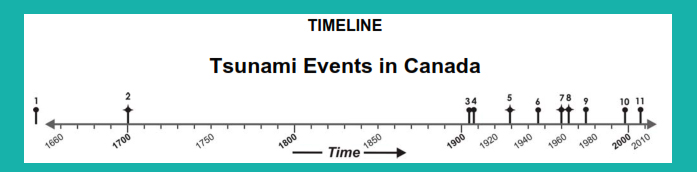
    Timeline

    Source: Catalyst for Science

    James Spencer, Registered Professional Biologist who currently manages JAS Projects as an Environmental and Economic Development Consultant, and Amelia received a contract through the Nuu-chah-nulth Tribal Council (NTC) to coordinate tsunami debris cleanups in all the 14 Nuu-chah-nulth Nations. So far,  they have organized two successful cleanups with Toquaht and Uchucklesaht First Nations (UFN).  They will continue to coordinate with Tseshaht, UFN, Hesquiat, Ahousaht, and Ditidaht.  To guarantee the continuity of this project, local First Nations must support the initiative.

    One of the main objectives is to raise awareness on how to respond to marine and tsunami debris in and on coastal territory.  Huu-ay-aht First Nations looks forward to working with its neighbours to get stronger and more in touch with nature as our ancestors taught us.

    Did you know?

    Enjoy this virtual exhibit about The Great Tsunami of 1964! Click on the image to see the gallery and read the stories:
    Virtual_Exhibit

    Tsunami Smart: Get the 101

    Other resources

    Emergency Info BC

    Remembering the 1964 Port Alberni tsunami

    This Week in History: Huge earthquake set off a tsunami that devastated Port Alberni

    Natural Disasters CBC Digital archives


  • Have you reported your harvest of wildlife?

    Please remember to report your harvest of wildlife on a Maa-nulth Wildlife & Migratory Bird Harvest Reporting Form (below).

    Your harvest information will be entered into the Maa-nulth Electronic Reporting Program (MERP). This information assists with wildlife population estimates for our Maa-nulth Wildlife Harvest Area and helps to track what our wildlife needs are as a Nation.

    Please send forms to either Government Office or fax to 250 728-1222. If you have any questions, please contact Christine Gruman, Manager of Natural Resources and Trade (christine.g@huuayaht.org) or Stephen Smith, Wildlife and Non-timber Forest Products Coordinator (stephen.s@huuayaht.org), both at the Anacla Government Office.

    Download the form here: Harvest of wildlife report

  • Submit your motions for the People’s Assembly 2015!

    Submit your motions for the People’s Assembly 2015!

    This is an archived post from 2015. The online form it originally included is no longer in service. For current information, see People’s Assembly.

    What would you like to see Huu-ay-aht accomplish within the next four years?

    You can answer this question or send your proposals as motions. They can be made on any subject. If you require assistance in the wording of them, the Law Clerk, Kim Chretien, and if necessary legal counsel, is available to help at no cost. If you would like assistance, please contact us as soon as possible and, in any event, by November 2nd to allow us time to draft it before the deadline.

    Motions submitted on November 3rd, 2015 will be added to the agenda for the People’s Assembly and included in the public notice. We strongly encourage citizens wishing to bring a motion to do so timely. Motions made after that date can be walked in, but there is no guarantee that they will be considered –the People’s Assembly will need to vote to add them to the agenda. In addition, the Executive Council will prepare and circulate reports on any motions on the agenda as of November 3rd, 2015, allowing you to be informed on the issues they will be asked to consider.

    The People’s Assembly is on November 20th, 21st and 22nd this year. You must register by filling the PDF/online form here  or calling 250-723-0100.  Accommodations at the Best Western Barclay and childminding will be supplied for the event.

    People’s Assembly updates

    Notice of motions

    Send your motions by calling Coraleah Johnson at 250.723.0100, Ext. 224.

  • NTC Health-Ability Fair 2015 offers you a healing experience

    NTC Health-Ability Fair 2015 offers you a healing experience

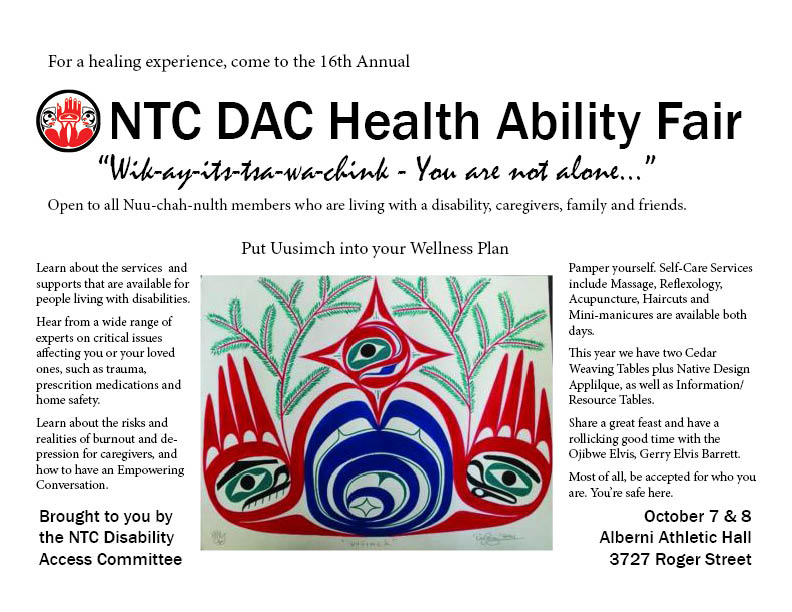
    The Nuu-chah-nulth Tribal Council’s Disability Access Committee is hosting the 16th annual Health Ability Fair on Oct. 7 and 8 at Alberni Athletic Hall.

    The theme of this year’s event is “Wik-ay-its-tsa-wa-chink ­– You are not alone,” and over two days, features an amazing range of presentations to improve the physical, emotional, spiritual and cultural well-being of Nuu-chah-nulth people and communities.

    “This year’s agenda looks exciting,” said NTC President Deb Foxcroft. “We’re incorporating our traditional wisdom, knowledge and teaching into healing and supports.”


    DAC Poster

    Foxcroft said this year’s fair puts a special focus on trauma and the effects it has on people with disabilities. That includes recent and “historical” trauma, she added. Researchers are now coming to a greater understanding of the long-term disabling effects of historical and generational trauma, and for the need to deal with the source of the distress in order to prevent disease.

    And, as has become a Health-Ability Fair tradition, there are also opportunities to pamper yourself. On both days, guests can sign up for massage, reflexology, acupuncture, haircuts or even a mini-manicure. For many, it can provide a much needed boost to their self-esteem, DAC Chair Helen Dick said.

    “I found out right in the beginning when we started offering haircuts and manicures … that is such an uplifting thing. It improved their self-esteem; they looked good, they felt good; they felt proud and went away feeling happy and good about themselves for the rest of the day, the rest of the week. It was a little piece of medicine that they needed at that moment.”

    “We have a lot of people who ask, ‘When is the Health-Ability Fair this year? I need a haircut,’” NTC Executive Director Florence Wylie said.

    There are also crafts and information/resource tables on hand both days. This year, due to popular demand, there are two cedar weaving tables.

    Opening ceremonies and introductions begin at 8:30 a.m. on Day One. Then, at 9:30 a.m., the Qu’aasa Cultural Team, Dave Frank and Joe Tom, leap right into the main theme with “Wik-ay-its-tsa-wa-chink ­– You are not alone.”

    Dick said a lot of disabled Nuu-cha-nulth members feel alone when they do not have access to services.

    “They fight through red tape, and then wind up right back where they started. And that’s why they feel alone,” she said. “This is why we felt it was important to let those individuals and all Nuu-chah-nulth know that they are not alone.”

    Dick said sometimes people have been turned down so many times, for so many reasons, that they become afraid to ask for help. One purpose of the fair is to help people make connections with other members of the community who are dealing with similar issues and have found the right solutions.

    The Qu’aasa Cultural Team is followed immediately at 11 a.m. by Clinical Counsellor Margaret Bird with a presentation on trauma. What is trauma? How can it affect us? What happens if we don’t deal with it? The emphasis is on the difficulties trauma can inflict on persons living with a disability.

    The afternoon features a Health Panel discussion at 1 p.m., with Shoppers Drug Mart pharmacist Bijan Mahmoudi speaking on the safe use of prescription medications, as well as potential interactions between prescribed medications, street drugs and/or alcohol. The NTC’s Non-Insured Health Benefits Coordinator Robert Cluett will give an overview on available programs and benefits, and more importantly, how to access them.

    At 2 p.m., Fire Services Officer Curtis Dick will speak on how to keep your home safe. Safety becomes even more critical and problematic in the event of disability caused by illness or injury, according to Wylie.

    “There are problems of accessibility. A lot of people have had to leave their communities because now they cannot even access their homes,” Wylie said. Families can become burdened with travel expenses, accommodation, medical devices and services.

    At 3 p.m., Autism Client Support expert Kevin Dhillon makes a presentation on new software he has developed for autistic children and adults.

    It isn’t all serious. Following a feast at 5 p.m., the Ojibwe Elvis, Gerry Elvis Barrett, takes to the stage for a stirring mix of music and stand-up comedy.

    To start off Day 2, Kim Rai, acting manager of the Teechuktl Mental Health Program, will give an overview of services available through Teechuktl and Qu’aasa.

    “We have a lot of residential school survivors who are living with disabilities and who have experienced trauma, and we feel it is important for him to explain to the participants where they are at as far as providing specific supports to clients,” Wylie said.

    At 10 a.m., Jess McConnell, senior manager of First Nations Health Authority for Island Health, will outline the services and supports available through his agency. At 10:30 a.m., clinical counsellor Donna Brown will focus on caregivers, and the very present risk of burnout and depression.

    Wylie said Brown’s message is that caregivers must create their own self-care plan or risk becoming consumed with the needs of their family member.

    “We want them to know it’s okay to take a break. It’s okay to ask for respite,” she said.

    At 1 p.m., Community and Health Services Training Coordinator Michael McCarthy will speak on Empowering Conversations.

    Then at 2:45, it’s time for an Open Dialogue, where participants can ask questions, share their experiences and provide feedback and suggestions to DAC and to NTC. Then it’s a wrap, with Dave Frank and Joe Tom on hand to provide a send-off.

    Dick said the whole event serves as a healing experience for people living with disabilities – even the most ordinary parts.

    “When they come for lunch, or they come for dinner, they have that time with their families and with their friends, being comfortable and (being) who they are. It’s a time when they feel important and that they are accepted for who they are.”

    “They are accepted unconditionally, and they feel safe there. And they know it,” Wylie said.

    Alberni Athletic Hall is located at 3727 Roger St.

  • Mark the People’s Assembly in your calendars

    More citizens attended last year’s Huu-ay-aht First Nations People’s Assembly than ever before. They sent a clear message that the Assembly is important to them, and so this year Executive Council decided to make it even better by adding a day.

    This year the People’s Assembly will take place on November 20 and will run until November 22. This will give citizens more time to celebrate their culture, socialize and meet up with friends and family, while still allowing time for the business that must be done.

    Following the success of last year’s Assembly, Huu-ay-aht First Nations also decided to continue to cover the cost of transportation and accommodations to its citizens. It is important to the Nation that its citizens gather in one location, and therefore it will continue to help make that affordable by paying for a two-night stay and the cost off travel to get to Port Alberni. In order to qualify for this gift, citizens must register in advance. The deadline for filling out a registration form is the end of October. You can register by filling out the online form or calling the Port Alberni Government Office (250-723-0100) and Helen Robertson will help you fill in the form.

    People’s Assembly Registration Form (PDF)

    This year the focus will be on Huu-ay-aht’s culture, with many opportunities to celebrate together and learn and celebrate cultural practices.

    More details will be available closer to the date.

  • Register now for Youth Cultural Day Camp

    Huu-ay-aht First Nation is pleased to announce that we will be holding our second Youth Cultural Day Camp in Anacla, running from July 20 to July 24, 2015.  The camp is open to youth between 10-15 years old. It is a day camp and will run from 10 a.m. to 3 p.m.

    Campers will have the opportunity to learn about Huu-ay-aht history and cultural practices and traditional territory and foods, as well as where we berry pick, hunt, and fish.  Camp activities will include hiking through our forests, as well as craft-making, singing, and drumming. The youth will also visit different culturally significant historical sites in Anacla territory.

    To register for the camp, please call and leave your name or the name of the camper you’d like to register at the Port Alberni office (at 250-723-0100), or the Anacla office (1-888-644-4555). Please make sure to fill out the cultural camp permission form (Camp Permission form 2015).

  • Come to our annual Loonie Toonie for the na-naniiqsu!

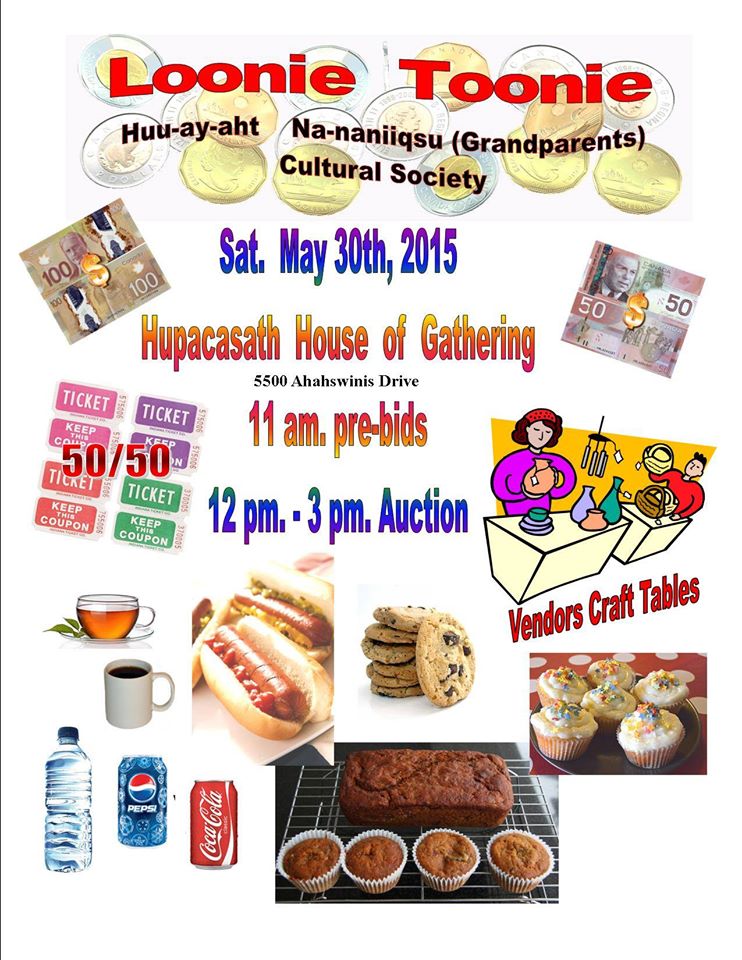
    Come to our annual Loonie Toonie for the na-naniiqsu!

    Huu-ay-aht Na-naniiqsu (Grandparents) Cultural Society invites members of the community in Port Alberni and areas nearby to its annual Loonie Toonie.

    • Saturday, May 30th
      Hupacasath House of Gathering
      5500 Ahahswinis Drive
      11:00 am pre-bids
      12-3pm auction

    Come spend the day of fun and laughter with family and friends to raise funds for Huu-ay-aht elders to attend the 39th Annual Elders Gathering.

    LoonieToonie

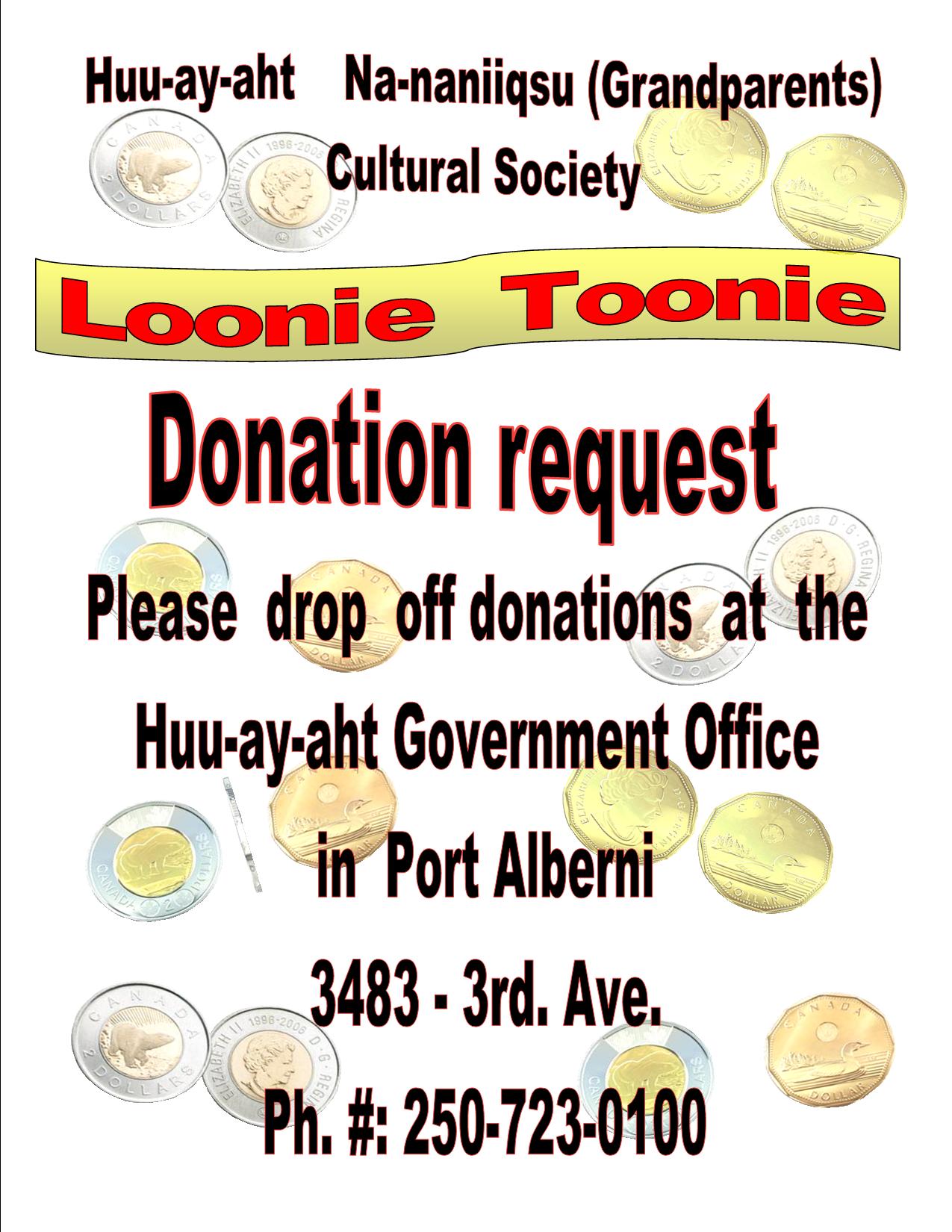
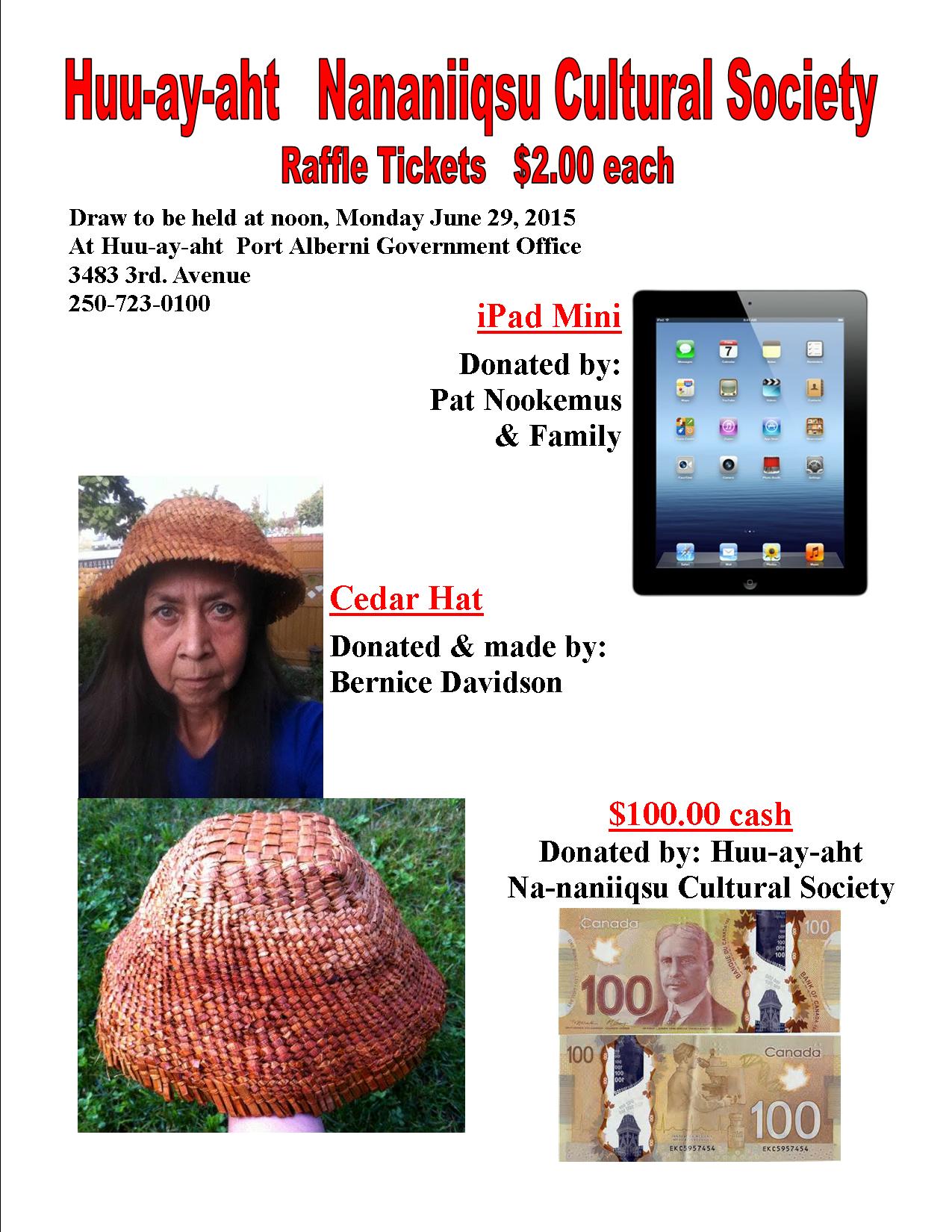
    Na-naniiqsu Donation request 2015 Nananiiqsu Raffle 2015

     The 39th Annual Elders Gathering
    The gathering will be hosted by Chief Harvey Underwood, councillors Allan Claxton, Louis Claxton, Samantha Etzel, Elizabeth Hermsen, Toby Joseph, Joel Pelkey, Stanley Sam, John Wilson, all the members of the Tsawout First Nation with support from all the W̱SÁNEĆ Elders.

    July 7-9, 2015, Panorama Recreation Centre, North Saanich, British Columbia.

    http://www.bcelders2015.ca/

  • Huu-ay-aht blessed logs for the W’SANEC Carving Project

    The W’SANEC Carving Project started about one year ago. Its main goal is to provide a more culturally safe environment at the Saanich Peninsula Hospital for people from its four Nations.

    Unfortunately, the hospital lacks of features that reflect the First Nations culture or honour the traditional territory in which the facility is built on. However, Island Health is committed to strengthen its relationship with Aboriginal People, improve their access to services and, therefore, their health.

    Huu-ay-aht, as a supporting neighbour within Vancouver Island, donated four 17 foot long yellow cedar logs to the program. Tsartlip- Charles Elliot (Brentwood Bay), Tsawout- Doug LaFortune (Saanichton), Pauquachin- Mark Henry and Tseycum- James Jimmy (both from North Saanich) are the carvers in charge of crafting four totem poles with the wood.

    “By having four beautiful welcome poles on hospital grounds, we hope this will welcome and encourage people from the communities to feel they can use the hospital services,” stated Jane Fox RN, Aboriginal Liaison Nurse, Saanich Peninsula Hospital.


    The blessing

    The blessing was performed by  Rob Dennis Jr., Wish Key, with the assistance of Cheryl Thomas, Cultural Program Coordinator, on February 12th. They wore traditional regalia for the occasion. The ceremony is called Eagle Down and helps to thank the Creator (Naas) for the life and spirit of the tree and to guide the artists in their journey to transform the wood.

    The unveiling of the totems is expected to coincide with the Elders Gathering between July 7th and 8th this year or happen by early August.


    More about the cedar

    Cedar is considered the tree of life, a symbol of strength and revitalization, but yellow cedar has healing powers too. Hilary Stewart explains in her book “Cedar: Tree of Life to the Northwest Coast Indians” (1984, p. 25) that the yellow-gold inner bark is exceptionally strong, like satin to the touch, more durable than red cedar’s and, therefore, the most suitable for carving.


    Alice Huang wrote an article about Cedar for Indigenousfoundations.arts.ubc.ca that includes the following beliefs:

    • Someone who cuts a tree down without permission would be cursed by other cedar trees.
    • A pregnant woman should not braid baskets as the umbilical cord would twist around the baby’s neck.
    • Because cedar is a long-lived tree, some Coast Salish groups guaranteed longevity by placing the babies in the stump of a large cedar.

    Just to refresh or enhance your Nuu-cha-nulth, try this expression: ʔuxaapw̕it̕asaḥ ḥum̕iis (Oogh-sop wit us saḥ ḥuu-mees), which means I am going to cut down cedar.

  • Rebranding our Nation

    In October, the Huu-ay-aht First Nations began a rebranding project that has wrapped up this week with the launch of the Nations’ new brand at the Community Engagement Sessions.

    This is an exciting time for Huu-ay-aht. The new logo, word mark and tagline was created after extensive consultation with the community, including meetings with Ḥaw̓iih, elders, youth and citizens. More than 127 surveys were conducted, and from that our new brand began to take shape. These surveys resulted in four power words that will be considered in the future. They are: Memorable, Strong, Connected, Informative.

    Why change? Rebranding is a necessary step as times change, and it allows the Nation to reflect the current societal needs. The new brand will let people know what we do and how we do it.

    This is becoming increasingly important now that Huu-ay-aht is a treaty nation. The new brand is a reflection of where the Nations began and a glimpse of where it is going.

    The Nation has made communication its top priority for 2014-2015. This new brand will ensure we are reflecting an image, both internally and externally, that is professional, timely and informative, while continuing to meet all of the power words chosen by Huu-ay-aht citizens (memorable, strong, connected and informative).

    Although the look has changed somewhat, the new brand respects Huu-ay-aht’s past while moving it forward into a bright future with a cleaner look and modern colours.

    The art is primarily the same design that was originally created by Ron Hamilton as a shawl pin for the Ḥaw̓ił at the time, Art Peters, which he gave to his daughters. Through the years, the art has transformed and other artists, like Ed Johnson Sr., have added their own innovations, but new versions have always built upon and integrated elements of those that have come before.

    The new tagline, “Ancient Spirit, Modern Mind,” honours Huu-ay-aht’s strong past and the traditions that are still important today, while acknowledging that the Nations is heading into a new era as a modern treaty Nation. This is the image Huu-ay-aht it presenting to the world, and it is one that shows how important the past is and how exciting the future will be.

  • Tour helps move Kiixʔin restoration project forward

    Huu-ay-aht’s traditional territories encompass some of the richest parts of Vancouver Island. Nestled along the coast line past Bamfield lies one of Huu-ay-aht’s most important historic sites – Kiixʔin.

    Together with Parks Canada and the Huu-ay-aht Development Corporation, Huu-ay-aht First Nations is moving forward on a plan to protect, enhance and share this amazing piece of history. On Wednesday, a group, led by Huu-ay-aht citizen Stella Peters and organized by Elected Councillor Sheila Charles, toured the site and discussed future plans for it.

    Kiixʔin is sacred because it is the site of the ancient capital of Huu-ay-aht. According to Huu-ay-aht’s ancient stories, the first man and first woman were dropped from heaven. The first man to appear was a deity named Nutchkoa. The woman was Ho-miniki, and she originated from the moon. She married one of the great Huu-ay-aht ancestors named Shewish.

    Carvings of these first ancestors were erected in 1860 and stood proudly for decades in front of the Ḥaw̓iił house in Kiixʔin. These welcoming figures are now in the Royal B.C. Museum in Victoria where they still welcome visitors in the traditional way. Replicas stand proudly welcoming people who come to the House of Huu-ay-aht in Anacla.

    The Huu-ay-aht are believed to have moved from Kiixʔin in the 1880s, but it remains an important cultural site for the Nation. The welcoming figures were brought to the museum in 1911, and little has been done to the site since then.

    Kiixʔin is believed to be the only site on the Southern coast of B.C. that contains undisturbed, standing remains of traditional First Nations longhouses. It is made up of four archaeological sites: the main village of Kiixʔin, including eight longhouses; the fortress site; a small midden; and a midden with remains of three houses. In 1999, Kiixʔin was officially designated as a National Historic Site by the Historic Sites and Monuments Board of Canada.

    Huu-ay-aht First Nations is now in the process of developing plans to open the site to tourists interested in learning about local First Nations history and culture. But before they do that, it is important to ensure that the proper steps are taken to preserve the site.

    The culturally significant area now has a trail leading to it, and so it is now more easily accessible by people. The group on the tour agreed that it is important to start planning because, as soon as people start arriving, the Nation needs to take steps to protect the site.

    One of the main discussion topics was the creation of a boardwalk and viewing platform. The platform would be above the site and would allow people to see the remains of the longhouses without entering them. The boardwalk would then lead them around the site, still keeping them from actually entering the sensitive area. It was also mentioned that having a boardwalk around the site would strengthen the message that the area deserves respect as a sacred site.

    The group also talked about the idea of creating a replica of the longhouses further down the beach. This would allow visitors to look at the authentic site, but also experience what the houses were like at the time.

    There was some debate about whether efforts should be made to preserve what remains of the original longhouses, but most agreed they should be left in their original state and allow nature to take its course. They also agreed that much of the undergrowth could be removed so that the long beams and the corner posts could be more easily viewed.

    In order to further protect the site, guardians would live at the site, much like at other parks. The group also said they would consider installing some kind of electronic monitoring, so the guardians can tell when someone enters the site. They would like to offer guided, interpretive tours, as well as interpretive signs for people who wanted to explore on their own.

    Everyone agreed that before anything is done plans have to be put in place. They stressed the importance of making sure the site is ready for visitors before they welcome them.

    The next step for the group is to review studies that have been done in the past, as well as looking at plans that have been discussed since the project first surfaced as an idea in the late-1990s.

    Funding for the project would come from Parks Canada, with Huu-ay-aht First Nations matching their contribution. Also, the Opportunity Development Agreement signed between Huu-ay-aht and Steelhead LNG includes a commitment of $25,000 from Steelhead LNG toward the preservation of Kiixʔin.