News Categories: Economic Development

  • Learn more about Culturally Modified Trees through this video!

    “Sacred Cedar: The Cultural and Archaeological Significance of Culturally Modified Trees” is a report of the Pacific Salmon Forests Project and the David Suzuki Foundation, written by Arnoud H. Stryd and Vicki Feddema. It explains that First Nations have utilized cedar for at least 3,000 years.  Wood- and bark-working tools found in archaeological sites helped discover this.

    The following video features the CMT that lays in Anacla near the entry to Pachena Bay. The intro states that “thousands of years ago, when the Huu-ay-aht people fished, hunted and carved their history into the cedar trees overlooking the Pacific Ocean, theirs were the only human voices. They had no idea that, one day, a giant ant would descend from the sky, pick up a chunk of one of those cedars and deliver it to their village…” Find out more about this story here:

  • “Indigenous Public Safety and Policing Forum” was a step toward change for indigenous peoples

    The Assembly of First Nations (AFN) Indigenous Public Safety and Policing Forum took place on March 30th,  in Regina, Saskatchewan, bringing together more than 80 delegates and speakers, including AFN National Chief Perry Bellegarde and The Honourable Ralph Goodale, Minister of Public Safety and Emergency Preparedness.

    “This forum brought together many of the parties required to create justice systems that work for our people and communities,” said AFN National Chief Perry Bellegarde.  “I am encouraged by the many community driven approaches underway.  Our people will continue to lead the way in developing creative solutions built upon our traditional values and First Nations justice systems with a goal of improving public safety and policing for First Nations and others across Canada.”

    “Undertaking this meaningful conversation with our Indigenous and public safety partners on issues related to gaps in  services in the criminal justice system, community safety and policing is a step in the right direction toward fulfilling the Government of Canada’s commitment to a renewed relationship with Indigenous Peoples,” said Public Safety and Emergency Preparedness Minister Ralph Goodale.

    The Forum featured discussions on Gaps in Services in the Criminal Justice System; Community Safety Plans and Protocols; Policing; and connections to the Truth and Reconciliation Commission’s Calls to Action.  There was a commitment from the federal government to renew, support and, based on direction from First Nations, revise where necessary the First Nations policing Program.

    The Forum brought together Indigenous organizations, federal and provincial policing organizations and other organizations to begin a dialogue on working towards improved public safety and policing for Indigenous communities and people.  Participants included representatives from the Inuit Tapiriit Kanatami, the Métis National Council, the Native Women’s Association of Canada, the RCMP, Office of the Correctional Investigator, First Nation Chiefs of Police, the Federation of Saskatchewan Indian Nations, the Indigenous Bar Association, Correctional Services Canada and others.

    The Assembly of First Nation is the national organization representing First Nation citizens in Canada.  Follow AFN on Twitter @AFN_Comms, @AFN_Updates and visit the AFN website at www.afn.ca.

  • Fresh Food Program is on hold

    Fresh Food Program is on hold

    The Fresh Food Box is currently on hold. The program is a non-profit alternative fresh food distribution system that started in May 2015 and was paid for, in part, through a one-time funding opportunity that the Nation received called the LNG Generations Fund.

    We are currently working on ways to locate funding to continue the program for another year and during this year develop a longer term solution.

    We will advise citizens as soon as we have further information.


    Fresh Food Box Program on Hold


  • AFN National Chief says that Federal Budget is a significant step in closing the gap for First Nations

    The federal budget is a significant step in closing the gap in the quality of life between First Nations peoples and Canadians and beginning the process of reconciliation, Assembly of First Nations (AFN) National Chief Perry Bellegarde says.

    “The budget begins to address decades of underfunding and neglect, which have perpetuated a growing gap in the quality of life between First Nations and other Canadians,” said AFN National Chief Perry Bellegarde.  “This budget invests in important priorities for First Nations and all Canadians. Investments in housing, clean water, education, and child welfare will bring long-needed relief for those living in third world conditions, and build a stronger economy for everyone.”

    The 2016 federal budget unveiled today is an historic $8.4 billion over 5 years in investments in Indigenous issues. It has committed to eliminate the 2% cap. It also allocates investments in First Nations Education; Infrastructure and Housing; Green Infrastructure on Reserve and clean drinking Water; First Nations child and family services; Aboriginal Skills and Employment Training Strategy; Aboriginal Languages Initiative; Health; Justice; Fishing and Environment. The federal budget also commits to engage with First Nations on a new long-term fiscal relationship.

    “Creating the conditions for First Nations peoples to succeed, whether they live in the north, on reserve or in urban areas, is the best economic stimulus plan for Canada,” said National Chief Bellegarde.  “It will add billions to the economy and save billions more in social costs while creating a stronger, more just and prosperous country for us all.”

  • Watch the webinar: “First Nations Social Innovation and Social Finance; First Nation Access to Credit”

    On Tuesday, March 22  at 1:00 pm (EDT) The Assembly of First Nations will be hosting a webinar entitled “First Nations Social Innovation and Social Finance;  First Nation Access to Credit”, with speakers from Employment and Social Development Canada (ESDC), Indigenous and Northern Affairs Canada (INAC) and Forrest Green, a Licensed Credit Bureau.  Highlighted are invited testimonials by partnering First Nations and First Nation financial organizations. The following have been invited: Pic River First Nation,  the Atlantic Policy Congress, Tribal Whi-Chi-Way-Win Capital Corporation (TWCC) and the Aboriginal Savings Corporation of Canada (ABSCAN)

    About this Webinar:
    Join us for this webinar as speakers discuss First Nation exclusion from the credit rating system, its impact on borrowing and the implications for economic development, employment, housing  and access to capital for First Nation individuals, corporations and governments.  A series of early adopters of the initiative will discuss First Nation community, political and corporate perspectives on this issue.

    To join the webinar on Tuesday, March 22nd, click on the link below:
    https://livestream.com/afn/fnaccesstocredit.

    About the Speakers
    Randy Jenkins  is a Senior Analyst with the Office of the Indian Registrar in the Department of Indigenous and Northern Affairs Canada.  He formally held positions as Senior Economic Analyst within the Community Infrastructure Branch and Senior Advisor within the Lands Branch where the credit initiative was first developed.

    Blair McMurren is Director of Social Innovation in the Strategic and Service Policy Branch at Employment and Social Development Canada (ESDC), where he is responsible for policy development as well as outreach and engagement related to the Government of Canada’s commitments to explore the potential of social finance.  He has recently helped to launch an Innovation Lab that will develop and test innovative solutions to policy, program, and service delivery challenges across the ESDC portfolio, in collaboration with other emerging public innovation hubs and labs.

    Murray Rowe Junior is the owner and President of Forrest Green registered credit bureau that is partnered with TransUnion a Consumer Credit Reporting Agency and Dun & Bradstreet a Global Business Credit Bureau.  For over 20 years, Murray has been supporting private and public sector clients by implementing technology solutions using credit reporting agency data, secure web portals, training, eLearning, automated workflow and intelligent documents. Murray has provided expert testimony to the House of Commons and Senate on credit issues impacting Indigenous Peoples.

    Invited:  
    Garland Moses, a member of the Ojibways of the Pic River First Nation, is employed as a Capital Housing Manager and is charged with the responsibilities of Capital and Housing responsibilities. Over the past twenty years, Garland has brought improvement to a new Water Treatment Plant which is currently extracting its water supply from ground source that is being treated with slow sand with an ozonation treatment system. In addition, Garland has assisted in the development of a new Daycare centre located in the community which is now known as Children and Family Learning Centre.  To support the overall need in wellness of the community and the surrounding area, Garland has been instrumental in the capital development of the Holistic Treatment Centre, the Biibaaban Healing Lodge. His latest support to the community infrastructure is the completion of a new office to support the Anishinabek Police Service. With the assistance of the Housing Committee support by our leadership and management team, the housing program has grown up to 160 residential units which includes a Senior Complex as well as a Six Complex which was recently completed in March 2010.  With the completion of the Six Plex, the Housing Program has completed a major part of the Ojibways of the Pic River Ten Year completion which addresses the need to construct up to forty residential units. Today, along with the Home Improvement Program, which has completed renovations to nineteen of existing residential structures, another eighteen units are currently in process and are slated for completion by the end of March 2011.  Garland was involved in the genesis of this initiative and continues to work through access to credit in the area of housing in Pic River.

    John Paul is the Executive Director of the Atlantic Policy Congress of First Nations Chiefs Secretariat in Dartmouth, Nova Scotia.  Taking direction from the Atlantic Chiefs through frequent All Chiefs Forums and Executive Chiefs Meetings, Mr. Paul provides policy analysis and strategic advice on a wide range of policy issues facing First Nations in Atlantic Canada and Eastern Quebec. The APC Secretariat’s mandate is to research, analyze and develop alternatives to federal policies affecting its member First Nation communities. Mr. Paul has a Bachelor of Arts in Community Studies and received his Master of Public Administration in Financial Management from Halifax’s Dalhousie University in 1982. A dedicated advocate for First Nations, Mr. Paul has worked toward positive change for First Nations communities in diverse policy areas for more than 25 years.

    Chief Shining Turtle has been the Chief of Whitefish River First Nation for 11 years and is family man with a strong desire to help his Community move forward. As an Engineer by trade, the Chief has helped his Community secure over 30-million dollars in new infrastructure funding; his drive and determination is extraordinary. Chief Shining Turtle’s education includes Bachelor of Engineering from Lakehead University, Diploma of Technology from Seneca College, a Technical Leadership Certificate from the University of Florida, and a Water Systems Supply Certificate from California State University.

    Jean Vincent, is the Vice-Grand Chief of the Huron-Wendat First Nation.  For the past 22 years, Chief Vincent has been the President and General Manager of the Native Commercial Credit Corporation (SOCCA), which provides commercial financing to Quebec Aboriginal-controlled businesses in the start-up or expansion phase.  He is also President and General Manager of the Aboriginal Savings Corporation of Canada (ABSCAN) offering Aboriginal peoples corporate bonds adapted to their needs; and financing in the form of secured loans in the real estate, institutional and commercial sectors. ABSCAN was incorporated on October 21, 2005 under Part II of the Canada Corporations Act to serve as a fund-gathering medium offering Aboriginal peoples control over their economic development.

    Brenda Zurba is the Vice President of Sales, Marketing & Development for Tribal Wi-Chi-Way-Win Capital Corporation (TWCC), a Winnipeg-based Aboriginal Capital Corporation. She brings 17 years of experience in marketing, sales, sales management and executive leadership as well as a post-secondary education in psychology, commerce and marketing. Brenda was employed with a publicly traded, multi-billion dollar organization for more than 10 years and led a nationally specialized team that consulted with small businesses across Canada to develop their annual and semi-annual marketing strategies. Prior to joining TWCC, Brenda served as the National Sales and Marketing Director for Telpay Incorporated, where she managed customer support, marketing operations, as well as multi-channel sales of 24 million transactions worth $14 billion annually. Brenda is a designated member of the Canadian Professional Sales Association, which is a national institute that provides guidelines and professional standards in the sales and marketing profession. At the 2013 Social Enterprise World Forum in Calgary, Brenda was a speaker on the “Building Indigenous Social Enterprise” panel.

  • Huu-ay-aht moves forward with plans for new businesses

    With tourist season fast approaching, the Huu-ay-aht Development Corporation is focused on ensuring the new businesses the Nation purchased in January are ready to welcome guests.

    The priority heading into spring is to get the turn-key businesses operational in a way that reflects Huu-ay-aht’s style, culture and values. The first step was hiring Bobby Toor as the new property manager. He will work closely with HDC’s General Manager Charlie Clappis and the existing staff to assess what is required to bring the motel and pub up to standard.

    Bobby is moving to Bamfield, along with his wife and two young children. They are currently living in Vancouver, and Bobby comes from a management background, having operated a facility that encompassed sports, fitness, bar and grill.

    No major construction is planned for any of the properties, but they will all get a facelift to help make them more welcoming and inviting.

    “We want to be fully operational by tourism season,” explained Gary Wilson, CEO of HDC. “But we want to ensure we reflect the pride Huu-ay-aht has in its culture and traditions in all of our businesses.”

    One of the first jobs Bobby will take on in his new role will be to set up infrastructure to offer administration, booking and other aspects of hospitality. This will mean exploring what technology is needed to bring the systems up to date and developing an online presence for the businesses.

    This year the Group of Businesses will offer a central location for all of its bookings, in addition to online reservations. If anyone wants to stay at the motels or the Pachena Bay Campground, they will be able to visit the float house on the government dock to get all of the information they need. Bobby will be working with Esther Jackway, manager of The Market, to make sure the float house is ready in time.

    Bobby and Charlie will also work with existing staff and begin the process of recruiting new people for the season. Many of the positions that will be filled for the busy season are already posted (http://hfndevelopmentlp.org/job-board/).

    One of the biggest changes that residents of the area will notice is that HDC will be moving the marine fuel station float assets from Ostrom’s Marine to the Kingfisher dock.

    “This is the first point of contact, so it makes sense,” Gary explained. “We already have a few competitors for fuel, so we need to consolidate the Ostrom fuel assets with our Kingfisher operations, so that we are more competitive.”

    He said moving the dock will also mean there will be a small convenience store on the water, since it is already part of the fuel station. Considering HDC recently acquired the assets, Gary still does not know exactly what the small store will sell, but he believes it will likely stock items for fishers and boaters.

    The Kingfisher, the Bamfield Trails Lodge (Bamfield Motel) and the pub were all determined to be structurally sound and the electrical is up to code. This means the repairs will be aesthetic ones, such as a fresh coat of paint, finishing’s, plus carvings and art from Huu-ay-hat citizens, and in the future we may incorporate a traditional house post to highlight the culture.

    Gary said this is an exciting time for Huu-ay-aht First Nations. Although many of the jobs are seasonal, he pointed out that the new businesses will create many opportunities for Citizens in terms of professional development in hospitality industry.

    “This is an opportunity for recruiting, training and developing Huu-ay-aht People to help us fully resource our own businesses for peak season.”

    He added that these seasonal jobs will get Citizens working, and then HDC can try to find other openings for them during the slower months. Gary also hopes the new businesses will offer Citizens with experience in hospitality a reason to come home.

    “We want to be in full swing by the end of March, but first comes the planning stages,” Gary said. “In the next month, HDC will be doing business and strategic planning sessions that will help create a vision for the whole organization.”

    HDC also has a contest running to help them name the motel and pub. For more details, check out this link: logo name contest poster

  • Huu-ay-aht Development Corporation says farewell to Stan Coleman

    Huu-ay-aht Development Corporation says farewell to Stan Coleman

    It was a time of celebration and sadness that the Huu-ay-aht Development Corporation bids farewell to its outgoing Chief Executive Officer Stan Coleman. Stan informed the HDC board last year that he would not be renewing his contract when it expired in January 2016. The board has since named Gary Wilson as his successor.

    Stan will be missed by the staff at HDC, the board and Huu-ay-aht First Nations as a whole. He began working for the Nation in 2011 and served five years as HDC’s CEO. In that time, he took the organization from a small forestry operation employing approximately 15 people to what it is today, with more than 50 employees.

    It has since grown from a forestry-based operation to one that has many businesses and responsibilities. This includes the Pachena Campground, The Market, Forestry, Fisheries, Gravel and, now, the new businesses purchased by Huu-ay-aht in Bamfield, a deal which Stan helped move forward. Although his contact continues until the end of January, HDC staff and board members hosted a going-away party for Stan at Chances RimRock Casino on January 13. Approximately 55 people attended, including staff, members of the board, representatives from Huu-ay-aht First Nations and business partners and contractors.

    stans gift

    “It was a chance to recognize what he created,” explained Tracy Walker, Executive Assistant at the group of businesses, “he made such an impact on everyone.” “He has a level of integrity that few could match”, said Martha Johnson, Accounting Assistant at the group of businesses, adding that they organized the party as a way of showing their appreciation for all that Stan has offered them, especially the staff. “We appreciate how far he would go for us,” Martha explained. “He has such dedication, and he has an eye for seeing potential in employees and fostering that. He is a great mentor.”

    She added that, during his time at HDC, Stan also brought in many outside contacts that have served to be extremely important in the operation of their businesses.

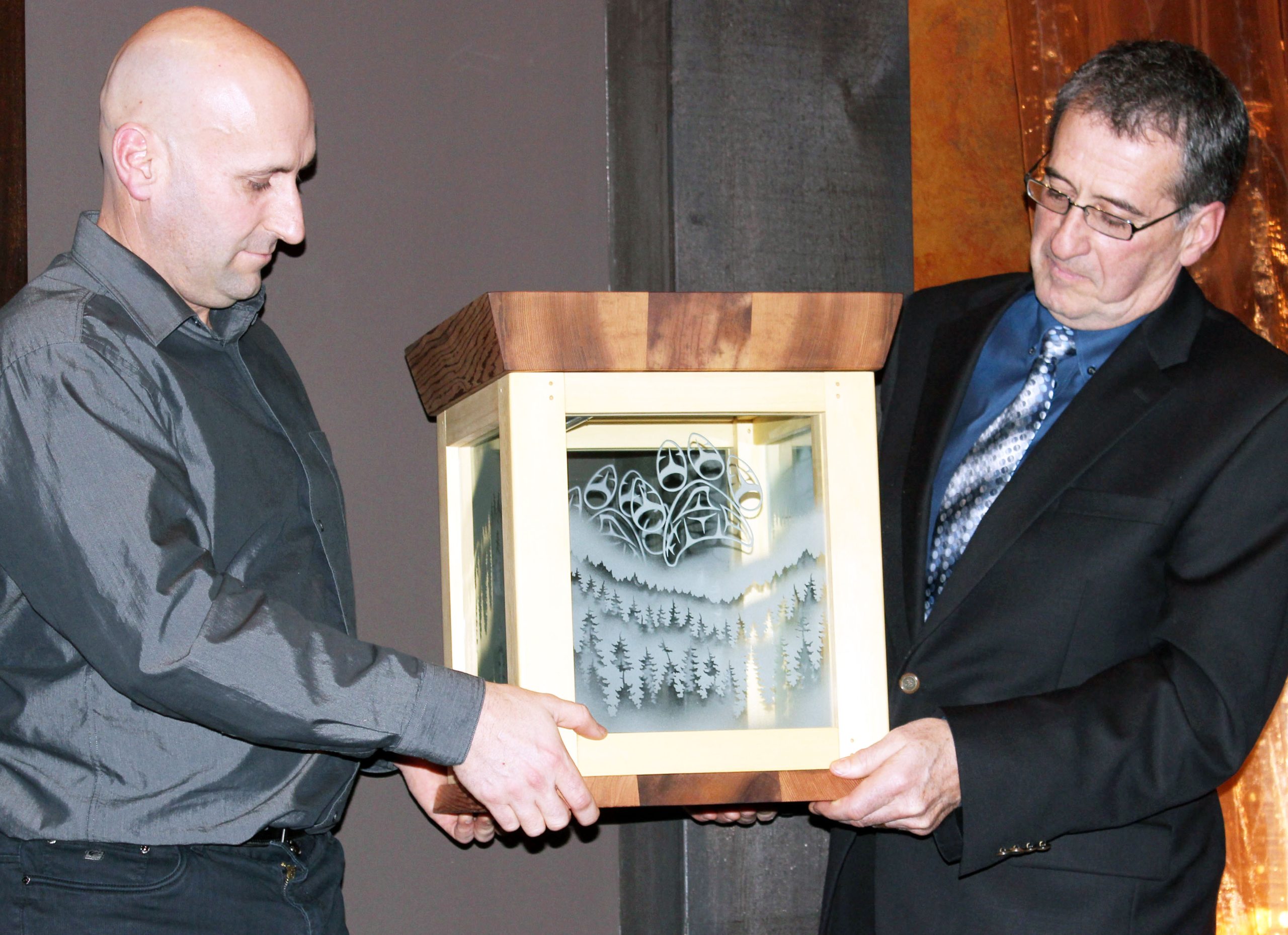
    “Stan has been uniquely committed to the Huu-ay-aht First Nations and the group of businesses over the years” said Angela Wesley, Board Chair. “He has not only been our CEO, he has become part of the Huu-ay-aht family, and although he has decided not to extend his contract, we know that Stan will never be far away and will continue to help us as we move forward”. At the party, the staff and board showed their appreciation to Stan by presenting him with a very unique gift. “The board, management team and staff will treasure Stan’s strong vision and commitment to leadership. The piece represents the wealth of knowledge and guiding light Stan has brought to the organization,” Martha said of the art designed for the outgoing CEO.

    The vision for the piece was a collaboration of ideas, from Martha and Tracy it also involved local artist Kelly Poirier and her team at White Raven Consulting, as well as Todd Robinson of Cascadia Glass Studios. The piece is a smaller rendition of art that is showcased at the Richmond oval, called the “Chiefs Treasure Box”. It is made of red and yellow cedar, etched glass and LED lights. It is a contemporary version of a traditional hupakwanum of the Nuu-chah-nulth People. Hupakwanum is the tangible embodiment of treasure.

    “The wolf paw represents the creation of the Huu-ay-aht Development Corporation, and Stan’s instrumental involvement in bringing HDC into fruition,” Martha said. “The landscape represents our land and resources, and Stan’s extensive background in the forest industry. Finally, the hammer stamp signifies the first Treaty Settlement Land cut block harvested under treaty.”

  • Purchase of properties by Huu-ay-aht is first step to revitalization of Bamfield Inlet

    Purchase of properties by Huu-ay-aht is first step to revitalization of Bamfield Inlet

    Huu-ay-aht First Nations is pleased to announce the purchase of a number of properties in Bamfield Inlet. The deal involves 11 parcels, and it represents a significant investment in the community.

    Purchasing these properties shows the Nation’s commitment to restoring its presence in the village that borders its Traditional Territory, located on the West Coast of Vancouver Island.

    Elected Chief Councillor Robert J. Dennis Sr. indicated that since entering into the Maa-nulth Treaty, Huu-ay-aht has maintained an interest in Bamfield Inlet due to its cultural and economic values.

    Tayii Ḥaw̓ił Derek Peters said, as head chief, he is proud that his Nation could make such a large investment.

    “By purchasing these properties, it will give my tribe more opportunity to play an economic role in the region,” he said. “Outside of our current forestry operations, it’s a good step into tourism.”

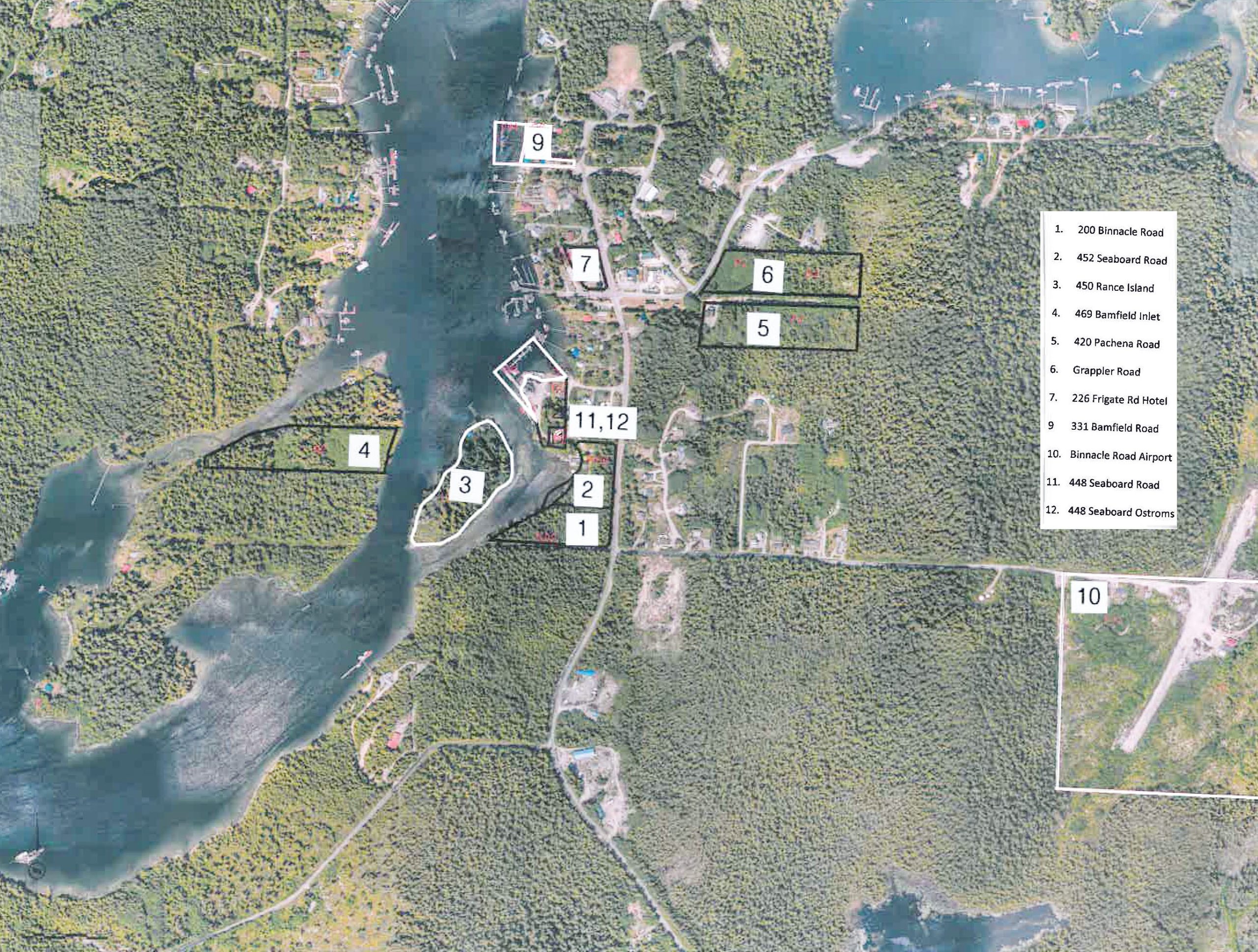
    The properties were bought as a package and include residential lots, businesses, land with cultural significance and land with future development potential. They are: Rance Island, a 6.8 acre parcel on the east side of the Bamfield Inlet; three acres on Binnacle Road; The Bay House on Seaboard Road, 6.11 acres along the Bamfield Inlet; 5.85 acres on Pachena Road; 5.36 acres on Grappler Road; 1.04 acres on Frigate Road; the Kingfisher Lodge and Marina on Bamfield Road; the Bamfield Airport, a 40-acre parcel on Binnacle Road; 0.275 acres on Seaboard Road; and Ostrom’s Marine on Seaboard Road, a 1.72-acre property.

    Huu-ay-aht has been investigating the opportunity the properties offer the Nation and the community of Bamfield since the spring of 2015. Chief Dennis said the work that the previous government put into this acquisition is greatly appreciated, and he is proud to see it receive support from citizens at their People’s Assembly.

    By closing this deal, Huu-ay-aht has made a commitment to their neighbours in Bamfield to continue to build a strong relationship between the small First Nation and the community members.

    “We have many citizens who remember growing up in what is now Bamfield Inlet,” Peters explained. “So to gain some of it back is a step in the right direction.”

    Over the years, Bamfield residents have watched as businesses closed and the properties that once housed them fell into varying levels of disrepair. By purchasing these properties, Huu-ay-aht First Nations hopes to breathe new life into the area and create a bright future for its citizens and residents of Bamfield. The Nation sees this as a potential springboard for revitalization of these historic properties and the economy in the area.

    “This is an integral piece to developing a strong Huu-ay-aht economy on our Traditional Territory,” explained Huu-ay-aht Councillor Trevor Cootes. “The Bamfield Property acquisition will be a cornerstone to the Nations’ Economic Plan, which will guide us into the future.”

    Moving forward, the Nation will be working with the community to establish a plan for the future. Huu-ay-aht’s elected chief indicated they will be hosting meetings to keep citizens and residents informed.

    “We want to build on the relationship we have with Bamfield residents,” Dennis said. “We will hold meetings with Bamfield residents and Huu-ay-aht citizens to inform them of the acquisition and our future plans.”

    Huu-ay-aht takes possession of the properties immediately. The first step will be establishing each properties potential and what role it will play in the future of the Nation. The Huu-ay-aht Development Corporation will play a key role in this process through the Huu-ay-aht Group of Businesses. CEO for HDC is optimistic that this purchase will open doors and create opportunities for the Nation and its neighbours.

    The day-to-day operation of the businesses will fall under the responsibility of the Huu-ay-aht Development Corporation.

    CEO Gary Wilson said their main focus will be ensuring there is a smooth transition, while adding Huu-ay-aht’s signature to current businesses.

    “We are looking forward to getting ready for the upcoming tourist season,” he said. “This will mean jobs and opportunities for Huu-ay-aht. We will focus on training and capacity building to enable us to participate in tourism and hospitality industry in the region.”

    He said Huu-ay-aht’s investment will offer benefit for the whole region and will offer the Nation an opportunity to share its culture.

    “We look forward to working with the Bamfield to revitalize the economy,” Wilson concluded.

    bamfield properties final

  • 2015 Huu-ay-aht Group of Businesses Dividend

    2015 Huu-ay-aht Group of Businesses Dividend

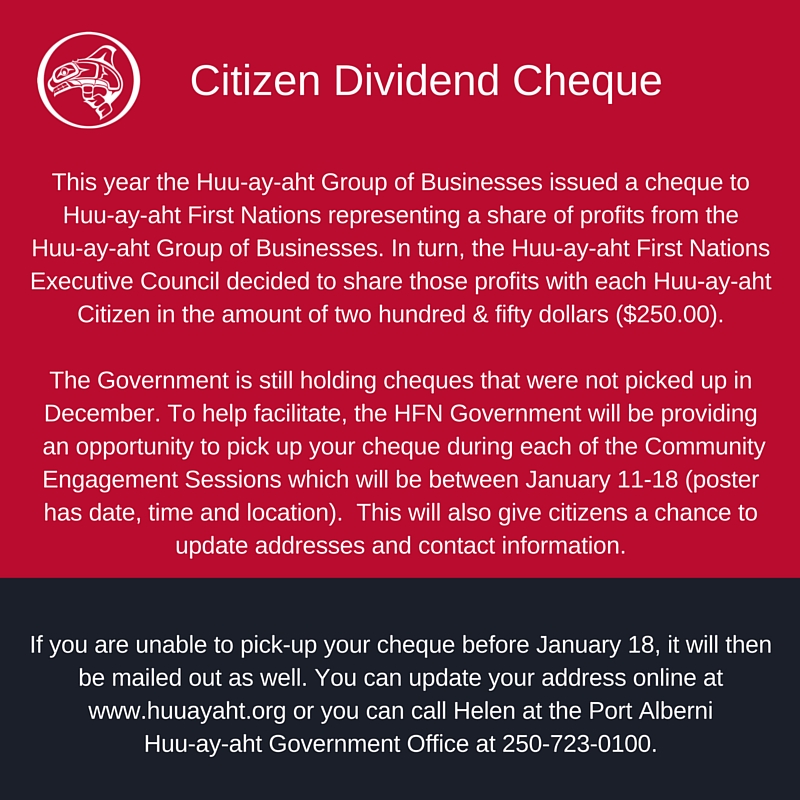
    Here is a brief update for the citizen dividend payment cheques.
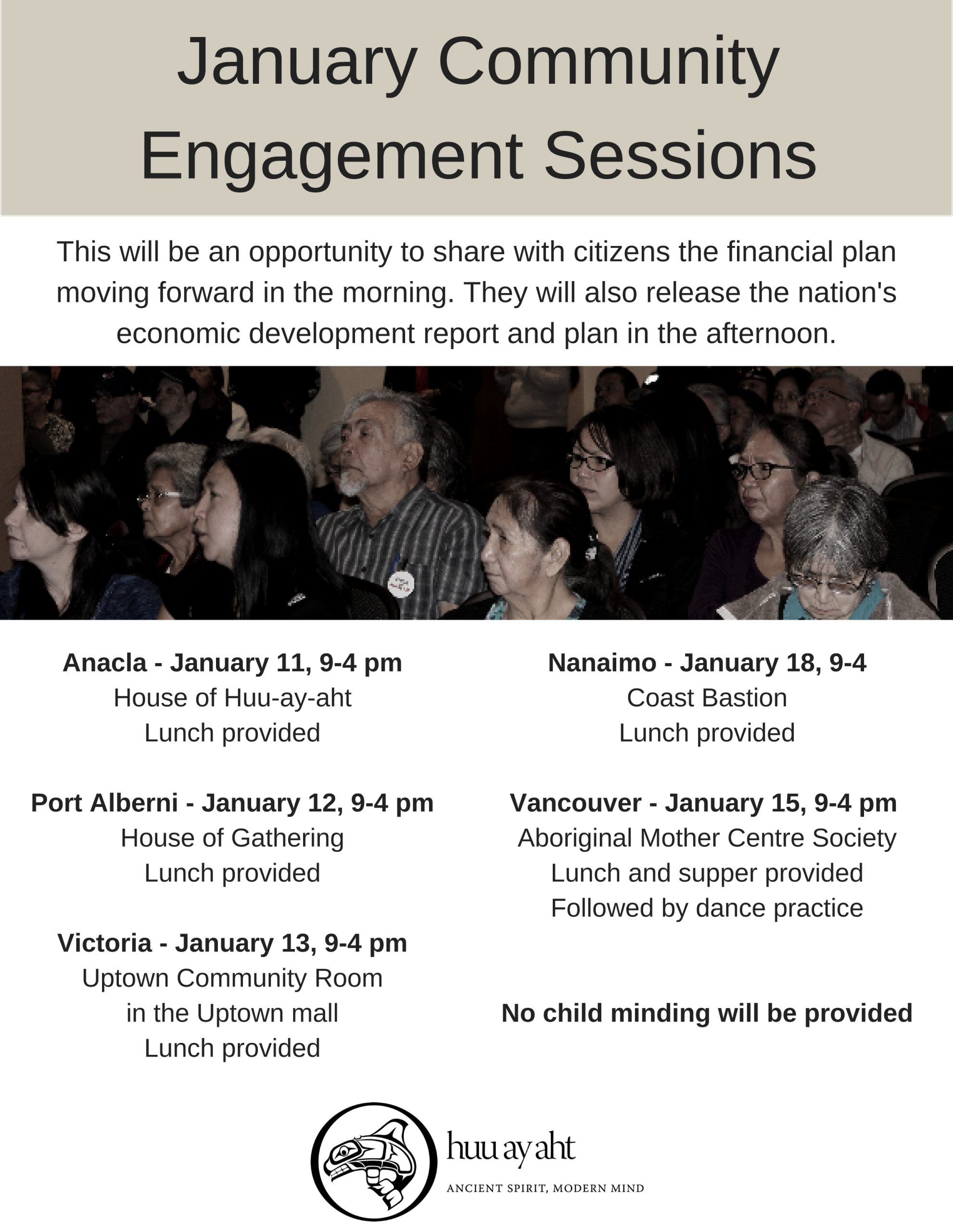
    Also included below are the dates for the January Community Engagement Sessions.
    To authorize someone to pick up your cheque, you need to complete this form and bring it to the pick-up location.

    Authorization Form

    Update Your Address Here

    Citizen Dividend Cheque (2)

    January Community Engagement Sessions

  • Come to our Community Engagement Sessions

    Come to our Community Engagement Sessions

    UPDATE: Victoria’s Engagement Session has been changed to today, December 18, 2015. They will be held at the Uptown Community Room in the Uptown mall, beginning at 5:30 p.m. with dinner and the meeting to follow.

    Our Executive Council has identified Economic Development as a top priority for the Nation.

    First thing in the new year, we are holding Community Engagement Sessions in Anacla, Port Alberni, Nanaimo, Victoria and Vancouver.

    This will be an opportunity to share with citizens the financial plan moving forward in the morning. They will also unveil the Nation’s Economic Development Report and Plan in the afternoon.

    čuu kʷaač (Join us!)

    January Community Engagement Sessions