News Categories: Culture

  • Huu-ay-aht to benefit from grant to help bring cultural property home

    When Huu-ay-aht First Nations finalized the Maa-nulth Treaty, one of the most exciting opportunities it outlined was a plan to bring cultural treasures home from BC museums.

    On May 17, the Province of BC and the BC Museums Association announced the 2020 Repatriation Grant recipients. Huu-ay-aht is one of 25 Nations to receive a grant. The Nation will receive $35,000 of the $454,000 grant to fund repatriation research and activities announced this week.

    “We celebrated together in 2016 as we watched as many of our cultural treasures were returned,” explains Councillor Edward R. Johnson. “Our history was extracted from us, and this is about bringing back a little bit of our history, one piece at a time, knowing that our treasures are scattered all over the world.”

    He added, this is a key part of recognizing the past and that Huu-ay-aht’s ancestors and treasures need to come home.

    “We are just scratching the surface of reconciliation by bringing some of our treasures home,” he said.

    The grant will be used to identify and catalogue the items the Nation wants repatriated from the Royal BC Museum. These will join the items previously returned in the Cultural Centre.

    Throughout the history of Canada, Indigenous peoples have had their belongings, language, culture, and even ancestors taken from them and housed in museums, universities, and private collections across the world. For decades, Indigenous leaders have worked tirelessly to support the return of their communities’ ancestors and cultural patrimony.

    Through the 2020 Repatriation Grants, the BCMA and the BC government are taking a critical step in reconciliation and supporting this work. These grants are funded through the B.C. government’s $500,000 investment in 2020.

    “These items were bought or taken from our ancestors, and it’s time that we bring them home where they belong,” explained Tayii Ḥaw̓ił ƛiišin (Head Hereditary Chief Derek Peters). “The effort made by the province and the museum shows respect for our history and reconciliation in action. It honours our our sacred principles of ʔiisaak (utmost respect), ʔuuʔałuk (taking care of), and Hišuk ma c̕awak (everything is one) and ensure future generations do not have to go to a museum to experience their history.” A full list of the recipients and the details of the grants can be found at this link.
  • MP Gord Johns meets with Huu-ay-aht

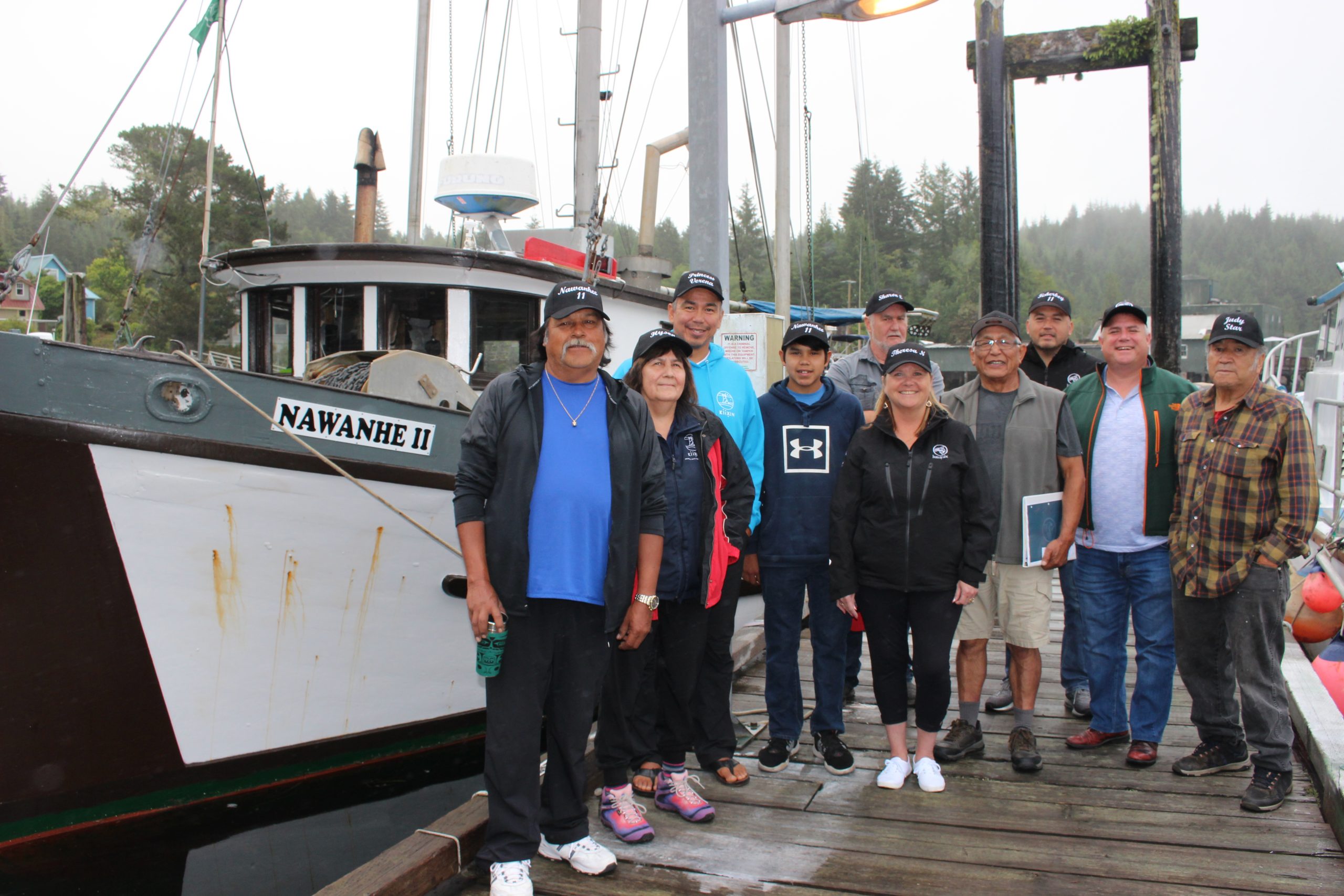
    Wednesday, August 21, 2019 Huu-ay-aht Executive Council, administrative
    staff and fishers met with Gord Johns, Member of Parliament for
    Courtenay-Alberni.

    Huu-ay-aht took the opportunity to focus on fisheries issues
    such as working with the Department of Fisheries and Oceans on policy changes
    that will enable Huu-ay-aht fishers to fish and make a reasonable living,
    enacting the “me too” clause and agreement (see August Uyaqḥmis), salmon renewal and enhancement
    and creating new opportunities. Elected Chief Councillor Robert J. Dennis Sr.  also shared stories of Huu-ay-aht’s strong
    history of boat building, and acknowledged present fishers and recognized the
    fishers unable to attend.

    Gord Johns followed the comments by Chief Robert J. Dennis
    Sr. and our fishers by discussing how he values the relationship with
    Huu-ay-aht and the other Nuu-chah-nulth and First Nations. The MP acknowledged
    British Columbia is experiencing a Salmon crisis. He would like to see a full
    salmon crisis campaign to support salmon fisheries including restoration and
    seeing licences in the hands of fishers, and a conclusion to the Ahousaht et.
    al case.

    After the meeting, the group headed down to the Bamfield
    dock to look at James Nookemus’ boat, Nawanhe II and gather for the Kiix̣in Tour. The tour was led
    by Stella Peters with additional comments and stories from Robert J. Dennis Sr.,
    Ed Johnson Sr., Councillor Edward R. Johnson, and Councillor Connie Waddell.
    This tour allowed Huu-ay-aht to give our MP a glimpse of Huu-ay-aht’s
    connection to the land and sea, and why fisheries and ocean resource harvesting
    are a central piece of Huu-ay-aht culture.

  • Keeping the Nuu-chah-nulth language alive, numaqimyisʔaqsup ʔiš hinatinyis

    Keeping the Nuu-chah-nulth language alive, numaqimyisʔaqsup ʔiš hinatinyis

    Hinatinyis and Angie Joe

    Angie Joe (numaqimyisʔaqsup) is one of Huu-ay-aht’s last fluent Nuu-chah-nulth language speakers. She is passionate about ensuring the language lives on in the next generation of Huu-ay-aht.

    Numaqimyisʔaqsup is often called on to help pass on her knowledge. Most recently, she has been working closely with hinatinyis (Brittany Johnson) as she navigates her way around her language teachings. Hinatinyis is the Nation’s Language and History Coordinator. Part of her role is to find ways to revitalize the language, but first she must learn it herself.

    Hinatinyis has been taking the UVIC Language Revitalization Diploma Program since the summer of 2018, offered remotely at the North Island College. The program is designed to create language teachers, it is a full-time course load of four classes per semester, and covers many different learning styles varying from linguistics, immersion-based learning, mentor-apprentice, and self-directed study.

    What started off as a get together, translating children’s nursery rhymes for the Pawaats daycare, turned in to a 700-hour mentor-apprenticeship. Hinatinyis and numaqimyisʔaqsuphave spent that time working together, travelling back and forth from Sarita (where numaqimyisʔaqsup lives), learning the Nuu-chah-nulth language.

    After the first 100 hours in the program, the two applied for funding from the First Nations Education Steering Committee (FNESC). They were approved and granted another 300 hours. After they completed with the funding from FNESC, they applied for another grant from First People’s Cultural Council and were granted another 300 hours.

    With the support of Huu-ay-aht First Nations, hinatinyis has had the privilege of learning the language as part of her job. With that, she has been able to complete the first year of her program as well as completing the 700 hours with numaqimyisʔaqsup.

    “For those who are hoping to make Nuu-chah-nulth their second language, you need to make time in your life for language,” she explains.

    She was inspired by an elder who visited her class, who said, “You need to speak it everywhere and use it every day.” From then, hinatinyis asked her family and friends to call her by her traditional name instead of her English name Brittany. Her name was gifted to her by her grandmother, it means “she is always welcoming.”

    The diploma program ends in December 2019, and Hinatinyis says that is not where her learning ends. It is a lifestyle choice.

    She plans to teach Nuu-chah-nulth language in Port Alberni and share lessons on social media. She would like to run an adult immersion group weekly that is open to all Nuu-chah-nulth learners and run various workshops for youth and adults. In the meantime, she is working on creating a short curriculum for youth to use while they play online games like FortNite. You can also find a basics pronunciation guide created by hinatinyis online at  www.huuayaht.org.

  • Nuu-chah-nulth Seafood wins BC Indigenous Business Award

    Awardees of the tenth annual BC Indigenous Business Awards were announced Monday night (October 15) by the BC Achievement Foundation, the program’s presenting organization. This year the Nuu-chah-nulth Seafood LP won in the category of Indigenous Business – Business Partnership of the Year.

    The awards were handed out at a gala dinner ceremony on October 15, 2018 at the Fairmont Hotel Vancouver. A delegate from Nuu-chah-nulth Seafood and Huu-ay-aht First Nations attended the event.

    The BC Indigenous Business Awards were launched in 2008 to honour and celebrate business excellence. A total of 16 Indigenous businesses, entrepreneurs, partnership entities, and community-owned enterprises will be recognized at this year’s gala dinner.

    The BC Indigenous Business Awards are:

    Young Entrepreneur of the Year
    Skywest Environmental Inc.
    Williams Lake

    Outstanding Business Achievement

    • Van – Isle Auto Brokers, VictoriaBusiness of the Year – one-to-two person enterprise
      Ay Lelum-The Good House of Design
      NanaimoOutstanding Business Achievement
    • Second Pass Forestry Ltd. , KamloopsBusiness of the Year – three-to-10 person enterprise
      Reciprocal Consulting
      West VancouverOutstanding Business Achievement
    • Haida Style Expeditions, Skidegate
    • Kootenay Waste Services Ltd., NelsonBusiness of the Year – 11+ more person enterprise
      Mussell Crane Manufacturing
      ChilliwackOutstanding Business Achievement
    • Kikinaw Energy Services Ltd., Fort St. JohnCommunity-Owned Business of the Year – one entity
      Yucwmenlúcwu (Caretakers of the Land) LLP
      EnderbyOutstanding Business Achievement
    • Painted Rock Aggregates & Contracting LLP , Savona
    • Quilakwa Investments , EnderbyCommunity-Owned Business of the Year – two or more entities
      Kanaka Bar Land and Resource LP
      LyttonBusiness Partnership of the Year
      Nuu-chah-nulth Seafood Limited Partnership
      Port AlberniOutstanding Business Achievement
    • Cariboo Aboriginal Forestry Enterprises Ltd., Williams LakeIndividual Achievement Award
      Chief Gordon Planes – Hya-Quatcha

    (Photograph Courtesy of Munro Thompson  Communications Inc – Brandon Thompson)

  • Families bring back Coming of Age celebration

    By Heather Thomson
    For centuries the First Nations of British Columbia have hosted Coming of Age celebrations, marking the time when a girl becomes a woman. The potlatch ban came into place in 1885, making traditional celebrations like this challenging. Many nations continued the practice in private, but they were not able to bring it out in the open again until the ban ended in 1951.
    Because they lost their traditional practice for so long, many families no longer celebrate life’s big moments through a community celebration like a potlatch.
    On Saturday, October 21, the Howard Family held a Coming of Age celebration for their daughter Helena Howard. Just before the event, Helena asked if her cousin Cierra Nookemus could join the celebration. Both young women were honoured and given traditional names.
    After receiving an invitation from Helena’s parents, Tammy and Cory Howard, I decided to attend the event. I wanted to help honour Helena. I was also curious and somewhat envious of such a rich cultural event, and so we packed up the truck with camera gear and made the trip to Anacla to check it out.
    Elders tell me this is the first time they remember a Coming of Age being celebrated in the House of Huu-ay-aht. Many of them said they could not recall the last time the Nation hosted such an event. This was a special day in Anacla.
    Lunch was served and everyone socialized at the House of Huu-ay-aht. The girls ran around visiting their friends and family. It was like any other luncheon in Anacla, that is until the girls were whisked away to the Anacla Government Office to get ready. I was asked to come over to take some photos, and when I arrived I could not believe the transformation. The young girls who were playing at the House of Huu-ay-aht only a few minutes earlier were gone, and two beautiful young women stood before my camera, all dressed in white and ready for their big moment.
    Back in the House of Huu-ay-aht, excitement was running high. The only comparison I can offer is when people wait to catch the first glimpse of a bride on her wedding day. Dancers gathered at the door with their shawls spread wide to keep anyone from sneaking a peek of the guests of honour before it was time. As eagle down began to float around the ankles of the dancers, rattles and a voice rose from the circle, drums followed, and finally two sea serpents emerged. As the voices and drums grew louder, a canoe began rising above the dancers, on the shoulders of men. Sitting in the middle were Helena and Cierra, with two guardians by their sides.
    The canoe made its way down the centre aisle and circled the front of the building. Dancers followed, all paddling to the beat of the drums and voices that sang out. Finally, with tears running down their faces, the young women were seated at the front of the room with their guardians.
    The emcee for the event explained the ceremony and its importance. He also introduced the four guardians and explained their role was to protect and guide these young women for the rest of their lives. This was also our responsibility, he explained, adding that everyone in the room plays a role in ensuring Helena and Cierra grow up with the knowledge that they are special and hold an important place in society – that they should be respected and respect themselves.
    Helena’s father, Cory explains that aside from receiving a new name and finding out who their relatives are, teaching the young women they deserve respect is the most important part of the event. “It’s about raising them up and showing off how important they are because they bring life into the world,” Cory explains. “They need to be reminded that they deserve respect.”
    Hereditary chiefs from several nations were then called up to wash the young women’s feet. Cory explains that this is an important part of the ceremony. By bowing down in front of the young women and washing their feet the chiefs are putting themselves below the young women, when they would usually be above them. It is a sign of respect and a way of honouring them on their special day.
    The final step in the official ceremony was giving each of the girls a new name. Helena was given the name of her grandmother Marie Nookemus, which has come from her grandmother before her – Kla-qwo-klee-nulth. Sara Dennis, hereditary chief for the Ka:’yu:’k’t’h’/ Che:k’tles7et’h’ Nation, offered Cierra her name, Kluu-ath-apee.
    As the drumming, singing, and dancing continued, the room was alive with excitement. People cheered and danced at their seats. The voices grew louder and more drums joined the circle as the Huu-ay-aht dancers joined the Howard family, the Muchalaht/Mowachaht Nation, for a shared song.
    It was then time to share a meal and socialize with friends and family, before the dancing and singing into the night.
    Looking back on the event, that feeling of cultural envy is even stronger. I think back to my own coming of age. I think I was taken to the local drug store for a quick shop for feminine hygiene products, told once a month I had to be careful in swimming pools, and sent on my way. It makes me wonder, if we all learned to celebrate this stage in life would women respect themselves more and demand the same of the men in their lives? If we marked this change in our life with pride, would men understand it is something they too should celebrate and respect?
    I hope that feeling of pride and respect follows Helena and Cierra through their lives, and that the message from Saturday is not forgotten. I also hope their Coming of Age celebration is only the beginning of many more big moments at the House of Huu-ay-aht.

  • UPDATE: Huu-ay-aht issues Request for Proposals for Canoe Carving Project

    This year, Huu-ay-aht First Nations wants to erect a new canoe at their Anacla Government Office, and so it has issued a request for proposals for this project. This was previously posted as a totem carving project.

    This program was designed to respond to these local labour market needs by providing participants with industry-recognized certificates and experience developing and sharing cultural stories and practices that are approved by their communities.

    The main objective of this project is to facilitate a carving project where a Huu-ay-aht apprentice, Executive Council, Ḥaw̓iiḥ, Huu-ay-aht administration and Anacla community members will carve a canoe together under the guidance of a Master Carver.

    The final product of this project is to have a carved canoe that can be displayed near the Huu-ay-aht Anacla Government Office. The goals of the project is to create community cohesion, provide a team building activity for HFN government and staff, and begin training a new carver. Additional objectives are that participants will learn from the Master Carver as they give guidance and direction on how to use the tools, cultural and logistical items for consideration, techniques, history involved with carving, and the symbolism of the art work.

    For more information, please refer to the complete Request for Proposals – Carving Project, 2017. For more information, please contact Kathy Waddell, Director of Community Services, kathy.w@huuayaht.org or by telephone at 250-723-0100.


  • Historic moment as Councillor John Jack named regional district chair

    The Alberni‐Clayoquot Regional District (ACRD) Board of Directors elected Director John Alan Jack as Chairperson of the ACRD Board for 2017.

    Director Jack has represented the Huu‐ay‐aht First Nations on the Board since their treaty government joined as a voting member in 2012. This is the first time in history a formal First Nation representative has served as Chair on a Regional District Board in British Columbia. Director John Alan Jack is a third-term councillor with the Huu‐ay‐aht First Nations, a member to the Maa‐nulth Treaty, which grants his community self‐government, ownership, and authority over land, as well as access and control over resources.

    Director Josie Osborne, the Mayor of the District of Tofino, was elected Vice‐Chair of the Board for 2017. Osborne served as Chair of the Board for the past two years. She decided not to seek re‐election of Chairperson for a third term.

    “In the past years, the Alberni‐Clayoquot Regional District has led the way in pursuing meaningful reconciliation with First Nations. We will continue down that path in a focused and respectful manner,” Jack explained. “I look forward to seeking and creating new opportunities in cooperation with and for the benefit of all in the region.”

  • Investment in Bamfield by Huu-ay-aht appreciated by residents

    In late January, the Nation purchased 11 properties in the Bamfield area. It took a lot of hard work to close the sale and even more to get the turnkey operations open and ready to accept visitors.

    On April 23, 2016, Huu-ay-aht First Nations invited its citizens, dignitaries, and residents of Bamfield to join them in a celebration to mark this accomplishment.

    The event exceeded all expectations, filling the Rix Centre for Ocean Discoveries for the luncheon and a large crowd gathered at The Hotel for singing, dancing, and a ribbon cutting. It was a chance for Huu-ay-aht to thank everyone involved in making it happen and welcome the community. It was also an opportunity for people in attendance to hear Huu-ay-aht’s vision for the future.

    Following this successful event, Tayii Ḥaw̓ił ƛiišin (Derek Peters) and Elected Chief Councillor Robert J. Dennis Sr. received the following letter and a photo collage from the day. He wanted to share it with the community.

    The letter follows:

    Gentlemen,

    I have been meaning to congratulate you both on your ribbon-cutting ceremony on April 23.

    Bamfield needed a fresh start and you have been doing a wonderful job of being that catalyst and including the whole community in your plans.

    Growing up in Bamfield in the 1950s and early 60s, I have watched the gradual decline of our community – first with the commercial fishing demise and then the stagnation of so much of the commercial property.

    I feel a hope for Bamfield again, which I have not had for some time. 

    Best regards and the best of luck on your venture,

    Marc Phillips


  • Listen to your Elders about “The Heart of the People”!

    This is the first part of the documentary “The Heart of the People”.  A unique opportunity to listen to Elders who are no longer with us, but speak about the Sarita River from the bottom of their tiičma (heart):

    • Willie Sport – cultural historian, fisher and trapper.
    • Lizzie Happynook – weaver whose pieces are exhibited at the Alberni Valley Museum.
    • Peter Joe – boat builder and former resident of the area.
    • Annie Clappis – member of the Huu-ay-aht Community Language Speakers.

    You can also understand the history around the Specific Claims Tribunal of the Huu-ay-aht
    First Nations regarding the value of the compensation Canada owes the Nation as a result of the way timber on former Numukamis IR1 was sold to MacMillan Bloedel in the 1940s. Forester Consultant Herb Hammond talks about how, in his opinion, the hemlock looper was used at that time as an excuse to log indiscriminately.


  • Learn more about Culturally Modified Trees through this video!

    “Sacred Cedar: The Cultural and Archaeological Significance of Culturally Modified Trees” is a report of the Pacific Salmon Forests Project and the David Suzuki Foundation, written by Arnoud H. Stryd and Vicki Feddema. It explains that First Nations have utilized cedar for at least 3,000 years.  Wood- and bark-working tools found in archaeological sites helped discover this.

    The following video features the CMT that lays in Anacla near the entry to Pachena Bay. The intro states that “thousands of years ago, when the Huu-ay-aht people fished, hunted and carved their history into the cedar trees overlooking the Pacific Ocean, theirs were the only human voices. They had no idea that, one day, a giant ant would descend from the sky, pick up a chunk of one of those cedars and deliver it to their village…” Find out more about this story here: