News Categories: Government

  • Councillors reflect on busy year at annual Legislature

    Huu-ay-aht First Nations held the first sitting of its Legislature on March 20, 2018 in the Council Chambers at the Anacla Government Office.

    Legislature is a time for Huu-ay-aht to pass the Budget Act, 2018 and deal with any outstanding business. This year, in addition to the 2018 budget, the members were doing the first reading of the Tribunal Act Amendment Act 2018. Speaker Angela Wesley opened the session by allowing each executive council member to make a statement on the past year and goals for the coming year.

    Chief Councillor Robert J. Dennis Sr. began by reminding everyone in the room of the importance of staying connected to culture.

    “It is important for people to understand how important our culture is to us,” he explained. “It is in everything we do and why we do it.”

    He reflected on the meaning of the word prudent and its importance. He said it means ensuring “we don’t always think with our heads, but also with our hearts.”

    The Chief Councillor pointed out that, although Huu-ay-aht has many goals, the most important for him is self-reliance. He highlighted the important steps the Nation took toward this goal, including the significant Specific Claims win. He also sees the Ancient Spirit Modern Mind document as important, and he pointed out that it is always with him and weighs into the decisions he makes as a leader.

    In the coming year, he wants to see some focus put on the Tyee House. He explained that when people come to the territory he wants them to have a place to do business – one that shows Huu-ay-aht has made an investment in its future. He praised the Huu-ay-aht Group of Businesses for having an even better year than before.

    “I felt a different buzz in the community this year,” he said. “More people are working and less attention is being paid to politics and more to running the businesses.”

    He said the Nation is doing a good job following and honouring the strategic plan, and he is confident this will continue and exceed expectations. He thanked senior staff for all of their hard work and stressed that nothing that was accomplished in the previous year would have been done without them.

    “I want 2018 to be better year,” he said. “This budget is bigger and better, and it reflects that the Nation cares about its people because they were consulted.”

    Councillor Ben Clappis said it has been a busy year and chairing the Hahouthlee Committee has been an interesting new challenge. He said, with so much to learn in his new portfolio, and he is appreciative of all the support he has received.

    He said the fishery side of his portfolio is always busy, and they are excited about new opportunities this year. He also shared that a number of Roosevelt Elk were transplanted into the Sarita area of Huu-ay-aht’s territory. The hope is these elk, many of which are pregnant, will help build up the herd in the area.

    On a personal note, Ben mentioned he and his wife Clara Clappis continue to act as a host home for Nuu-chah-nulth foster children, offering them exposure to their culture when they visit the territory.

    Councillor Connie Waddell said her portfolio of Treaty Implementation is hard to measure, as it spins off in many directions. She believes they have made great progress recently.

    “As I spend more time working with the other Maa-nulth Nations, I know we are moving and making progress,” she said. “This council has been very aggressive in developing a budget and having great discussions about the opportunities ahead of us.”

    She said the whole idea of this portfolio is to show citizens how the treaty is working for them and how many benefits it brings to the Nation and its citizens.

    “Seeing it come alive and off the page is what I’m excited about,” she said of the Treaty. “My goal is to educate citizens as much as possible of how they can benefit.”

    She highlighted the new crab licence opportunity, additions to the Treaty Settlement Lands, and lots of positive work in Natural Resources in the Hahouthlee. These are big successes, and she is looking for even more in what she believes will be a very busy upcoming year.

    Councillor Sheila Charles welcomed the citizens in the room and expressed her appreciation to them that they are taking an interest in their Nations’ business.

    She echoed many of the councillors’ comments that it has been an extremely busy year. She said, at first, she felt like she was just hanging on, now she feels like everything is moving very fast, and in the right direction.

    “I can’t believe we only have one year left in this term,” she said. “It’s really exciting times.”

    For many years Sheila has been working to create programming that would help families and children in care. Although it took a lot of work and at times she thought it would never move forward, she said, “the Social Services Project turned out better than I could have imagined.”

    She said once she came to the realization that this was about addressing intergenerational trauma, she began to see how the program should come together. With that focus, she was able to present the project in a way that received support from other council members. She stressed the importance of advice she received early on to draw down the social services jurisdiction. From there the panel was formed and they began making progress with a prevention and support-based model.

    “Today we are doing something – we are offering support,” she said. “I’m looking forward to seeing the numbers of children in care drop to zero – then I’ll know this program has done what it can to support and prevent the kind of trauma we have seen for generations.”

    She gave much of the credit to the team that has been built at Huu-ay-aht.

    “I hold my hands up to all staff – we couldn’t do it without your support.”

    Her goal for the future is to see people living a healthy, thriving life and have the world look at the Nation and say “look what Huu-ay-aht is achieving.”

    Councillor Trevor Cootes said lots is going on in his portfolios of Economic Development and Infrastructure, and he thanked council for all they do to support him.

    “We’ve always known what we want as a Nation,” he said. “We achieve it because our elected and hereditary government works together, and that gives us the best foundation for making decisions.”

    He said it is nice to finally see progress on the Kiix̣in tourism plan, one he saw first as an idea in 1988. He expressed his appreciation to Wišqii and Stella Peters for the excellent job they did on the tours last summer. He said guiding comes down to mostly personality and being able to connect with the people visiting, and Stella and Wišqii did that seamlessly between them, immersing the visitors in the Nation’s culture.

    In the future, he would like to see more engagement between the Nananiiqsu and Huu-ay-aht youth.

    “All success is connected to this,” he said, explaining that his own children taught him this recently. “I hope in the future to bridge that gap.”

    Other successes he shared included the BC Hydro micro-hydro power project, the success of the Huu-ay-aht Group of Businesses last season, and an increase in tourism in the area.

    In the coming year, he looks forward to building on the work with Pacific Rim park, as they move toward the 50th anniversary of the park in 2020, which coincides with the 20th anniversary of the House of Huu-ay-aht.

    Over the phone, because of the recent birth of his second daughter, Councillor John Jack said it has been so busy this year, and it makes him appreciate even more all the work people are doing for the Nation on every level. He said the Nation has always done business in an organized and professional way.

    “We can be proud of what we have achieved and that we have a plan,” he said. “We are not seeing success just because of the Treaty, but because of how we approach things.”

    He stressed the importance of continuing to focus on outcomes and doing what the Nation needs to do to achieve them.

    Kwispaa LNG has seen many successes this year, he explained, because it has been approached in a professional, inclusive manner. He said this includes the LNG Advisory Group, the Project Oversight Board, and government relations efforts. He said it is by continuing to build relationships that we will be successful in the future.

    In his Financial portfolio, he said it is important to “catch up and keep up” to the rest of Canada.

    Language and culture are two essential areas on which the Nation must focus in order to conserve and promote them, he explained. He said the Nation must teach the children their language, so that way in the future they can direct-teach their own children.

    The recently announced federal treaty loan forgiveness was very positive, John explained, but it is important that the money is used wisely to achieve the Nation’s goals.

    “The strength of our government is based on the quality working relationship between elected government, Ḥaw̓iiḥ, committees, and administration,” he said. “The strength of governance depends on staff, and we have that.”

    In the coming year, he is looking forward to working with the Alberni-Clayoquot Regional District on the plan to bring recycling to Huu-ay-aht First Nations.

    “It may not be sexy, but it’s a testament to what we can do if we build relationships,” he said. “If we lead strongly, we will leave a strong future for the next generation.”

    Following the opening remarks, Connie Waddell presented the Budget Act, 2018, for John Jack. Members of council passed the first reading of the Budget Act, 2018 with a number of additions and conditions.

    After the act was originally recommended by the Financial Committee, Council identified an additional line item, related to the cultural tourism and Kiix̣in. Executive Council later approved the amended act, and added additional matters relating to elder care and to disbursement of funds to citizens that will require additional spending authority.

    Ḥaw̓iiḥ Council was scheduled to review the budget, but that meeting did not end up occurring. After the Finance Committee reviews the amended act this week, it will go before the Ḥaw̓iiḥ Council before the second and third sitting of Legislature.

    The Tribunal Act requires that the chair and vice-chair each must have at least 20 years of experience as a practicing judge or lawyer. The vice-chair position has been empty for some time, and so the recommendation is that this be reduced to 10 years. Ḥaw̓iiḥ Council offered its support in this change, and at the People’s Assembly this year the motion to amend the act was passed. At the first sitting of Legislature, members passed the motion to amend the Tribunal Act.

    That concluded business for the first sitting, and the meeting was adjourned. The second and third sitting of Legislature will take place on March 29, 2018 at the Anacla Government Office, in Council Chambers. Citizens are encouraged to attend.
  • Huu-ay-aht and Western continue along shared path to reconciliation

    Huu-ay-aht First Nations and Western Forest Products Inc. (Western) today announced the signing of a Reconciliation Protocol Agreement. This agreement continues progress along the shared path to reconciliation and a joint vision for a safe, competitive and forward-looking forest sector in the Alberni Valley.

    Founded on mutual trust and respect, the agreement affirms the parties’ commitment to seek mutually-beneficial solutions that work to achieve their respective interests, while also developing inclusive opportunities that bolster the long-term sustainability of the forest sector in the Alberni Valley.

    “Long-term sustainable revitalization of the forest sector in the Alberni region is a critical component of Huu-ay-aht’s efforts to achieve reconciliation, self-reliance and a brighter future for Huu-ay-aht citizens and everyone in the region,” said Chief Councillor Robert Dennis.

    This ground-breaking approach guides how Huu-ay-aht and Western will work collaboratively with different forestry tenures, assets and interests to explore opportunities that improve the economic vibrancy of the Huu-ay-aht Ha-houlthee (traditional territory), including Huu-ay-aht Treaty Lands, and the broader Alberni Valley while respecting the three sacred principles of the Huu-ay-aht people: hišuk ma c̓awak, – “everything is one”; ʔuuʔałuk – “taking care of”; and ʔiisaak – “greater respect”.

    “Our protocol with Western is an important next step on the road to reconciliation. We look forward to working with the Province and everyone in the Alberni Valley to make forest sector revitalization and reconciliation a reality,” said Chief Hereditary Chief Tliishin, Derek Peters, “Most importantly, Western is committed to fully respect Huu-ay-aht sacred principles.”

    “Reconciliation requires a shared vision of the future, along with trust and an unwavering commitment to embark on that journey together,” said Shannon Janzen, Vice President and Chief Forester for Western. “Huu-ay-aht and Western are starting the hard work required to give reconciliation meaning and Western looks forward to building on this going forward. This Reconciliation Protocol Agreement is just one step on the path towards a better, more sustainable future for everyone.”

    The Reconciliation Protocol Agreement builds on Huu-ay-aht’s and Western’s agreement in 2017 which included Huu-ay-aht’s purchase and long-term lease-back of Western’s dry-land sort at Sarita, a timber sale from Huu-ay-aht’s Treaty Lands, and an employment and training agreement. Together, Huu-ay-aht and Western are implementing those agreements as they look for opportunities to operate across a larger land base.

    Huu-ay-aht and Western recognize that the way forward involves working closely with everyone in the Alberni Valley, and looking at different ways to achieve value from the forest land base to increase the economic vibrancy of the region. The parties believe that by everyone working together, a brighter future can be achieved.

  • Huu-ay-aht declares public health emergency and demands the Province do better for First Nations children in care

    Today, Huu-ay-aht First Nations declared the treatment of Huu-ay-aht children by the Province of British Columbia a public health emergency.

    “Despite the provincial government saying it is a priority, we continue to see the number of Huu-ay-aht children in care increase,” says Huu-ay-aht Chief Councillor Robert J. Dennis. “The time for endless talk is over – we demand British Columbia take action. It’s time for the province to cooperate and do its part – this is a public health emergency.”

    Since August of 2017, Huu-ay-aht has started implementing the 30 recommendations of the Huu-ay-aht First Nations Social Services Panel Report. These recommendations aim to reduce the number of children in care and ensure Huu-ay-aht children grow up safe, healthy, and connected to their home, culture, and values.

    To date, Huu-ay-aht has funded the project on its own, paying more than $600,000 of the $1.8 million per year required to implement the recommendations. However, the independent panel made it clear Huu-ay-aht cannot be expected to go it alone. Successful implementation of the the Panel Report recommendations is a shared responsibility and depends on the provincial and federal governments providing immediate funding, cooperation and jurisdiction to address this emergency.

    “We have a plan that can bring the number of children in care to zero, but we have not received support from either the provincial or federal governments. When we started working on the recommendations from our Social Services Panel, our Nation had 34 of our 220 children in care, and 25 were in non-First Nations homes. That number is now 47, with 36 in non-First Nations homes,” Chief Dennis says. “I was shocked to hear it was increasing. There is a better way, and we need the province and federal government to immediately do their part to find a solution to this crisis for all First Nations communities.”

    The need for immediate action was highlighted this week when lawyers for the Ministry of Children and Family Development (MCFD) sought to reduce the access the BC Supreme Court had earlier ordered to ensure that one Huu-ay-aht mother and baby could sustain breastfeeding and their maternal/infant bond. Huu-ay-aht challenged the province after it removed a newborn without warning from its mother in a completely unwarranted manner. Huu-ay-aht First Nations had been forced to seek emergency relief from the Supreme Court to ensure the maternal/infant bond was not irreparably harmed while they were forced to wait for Ministry and court processes to unfold.

    Chief Dennis says, “This case is a clear example of everything that is wrong – this system is broken.”

    In a recent article in the Globe and Mail, representative for Children and Youth Bernard Richard, who has read all the files connected with the case, including those not publicly available, said the Ministry’s handling of this case “is egregious and awful,” “reeks of paternalism,” and “raises concerns about systemic racism.”

    Such an approach to child welfare by MCFD persists, despite solemn promises from the provincial NDP government to improve the child-welfare system.

    “In contrast to this recent apprehension of the newborn, we were able to place another child requiring care in a Huu-ay-aht home due to the quick and ongoing implementation of the Panel’s recommendations,” says Chief Dennis. “While we strive to keep families together, at least in this case, we were able to find the best solution for the child – one that ensures continued access to the child’s own family, culture, traditions, and land.”

    The Huu-ay-aht home that was able to help this child was one of the extended family homes that Huu-ay-aht had offered to MCFD to assist the mother and newborn at issue in the Supreme Court ruling. However, MCFD would not consider or accept this home as an option, without explaining why not.

    Chief Dennis points out that both the federal and provincial government say they want to keep First Nations families together and provide better supports to keep children out of care. But, the reality is the number of children in care continues to increase.

    Huu-ay-aht First Nations expects a full response to this public health emergency at a meeting with MCFD officials on March 15, 2018. Huu-ay-aht also intends to meet with the federal government on this topic next week. At these upcoming meetings Huu-ay-aht expects the province and federal government to provide Huu-ay-aht with immediate funding, cooperation and jurisdiction to address this emergency.

  • BC Supreme Court grants Huu-ay-aht mother more access to her newborn

    Huu-ay-aht First Nations won an important case in the Supreme Court of British Columbia on Tuesday that grants a young mother more access to her new-born child to ensure breastfeeding and bonding are not further harmed.

    “This is an important victory,” explains Maegen Giltrow, legal counsel for the mother and Huu-ay-aht First Nations. “This decision will impact how the Ministry of Children and Family Development works with Huu-ay-aht First Nations, and it has the potential to impact other First Nations in Canada. The Court has held the Ministry to a higher standard than what we’ve been seeing.”

    The 20-year-old mother (LS) was shocked when the Ministry of Children and Family Development apprehended her baby girl (VS) on January 16, 2018, three days after she was born, without any credible reason. Since that day, Huu-ay-aht and the Nation’s legal counsel have sought the return of the child to her mother. Huu-ay-aht staff, government, and legal counsel have continually pressed for less disruptive measures and better access to the baby so that her mother could breastfeed and bond with her baby.

    Even though LS lives in Port Alberni, the baby was placed in Courtenay. Since then, her mother has been living out of a hotel in Courtenay so she can get every minute of access to her baby available. However, the Ministry had been allowing her only 2 hours a day, with no access on weekends. She has been struggling to maintain breastfeeding and bonding under these conditions.

    Furthermore, under the existing process in Provincial Court under the Children, Families and Community Services Act, LS wouldn’t have an opportunity until 66 days after the removal for a hearing before a judge to argue the removal was unwarranted and less disruptive and intrusive measures are available that do not involve breaking the bonding and attachment between her and her daughter.

    LS and Huu-ay-aht turned to the Supreme Court for help.

    The Ministry had argued that the Supreme Court should not hear the mother’s application because the Court did not have jurisdiction. The Court held, however, that the Ministry’s argument only “highlights just how impossible and unfair” the “hopeless situation” the mother is in is. The Court invoked the rarely used but important Parens Patriae jurisdiction that allows the court to step in to protect the interests of children and vulnerable people. The Court held it had the power to, and should, step in to protect the child, rather than letting this situation carry on as the Ministry was proposing.

    The Court ordered the Director to increase the mother’s access to the child to ensure that breastfeeding is not interrupted, and the maternal bond is not harmed.
    This means more natural access, morning, mid-day and evening, weekends included. The Court also held that the Director of Child and Family Services has an obligation to consider and respond to the concerns and proposals put forward by the Nation for healthier access that would allow the mother to be with her child in a safe and nurturing environment with supports from her family and her Nation. The Court ordered the Director to consider and respond to these proposals within two days of the order. These proposals had all been previously left unanswered by the Director.

    Huu-ay-aht is celebrating this as an important victory, and its first since implementing the 30 recommendations from an independent Social Services Panel on how to “Bring Our Children Home”, and stop the cycle of breaking Huu-ay-aht families up into the foster care system (Full report: https://huuayaht.org/social-services-project/ ). report outlines the steps the Nation will take to reach the eventual goal of having no Huu-ay-aht children in care. It approaches the issue with a preventative approach that is designed to protect and support both the children and the family.

    The findings of this report speak directly to this issue. It says, “Attachment is a natural connection that occurs between a baby and his or her caregivers for life. It begins as newborns and continues as the child gradually forms sense of who she or he is.” The report continues that, “Attachment helps a child feel safe, loved, and protected. In traditional societies, it also gives a sense of belonging to one’s tribe or nation.”

    “The Court used an ancient jurisdiction to protect this child,” says Huu-ay-aht Councillor Sheila Charles. “This is exactly what Huu-ay-aht is doing – relying on our ancient ways to protect and nurture our children.”

    Because the Nation has already implemented many of the recommendations from this report, it was able to offer the mother what she needs to fight for her child. This includes 24-hour emotional support, legal advocacy, cultural support, assistance with travel, accommodations, and food while she remains in Courtenay, counselling, parenting education, and supervision support for when she visits with her baby.

    The Federal Minister of Health Jane Philpott has called the number of indigenous children in care a “humanitarian crisis,” and the Premier’s mandate letter to Minister Conroy expressly directs her to “Work to implement the recommendations from Grand Chief Ed John’s report and provide better supports to keep Aboriginal children at home and out of care.”

    However, despite recognition at the highest political levels that the child welfare system is broken, and that we must stop scooping indigenous children into care and away from their families and communities, “this case has repeated all the patterns of the past, which only serve to hurt our children and our families, and don’t allow us to heal,” says Charles. “Tuesday’s Supreme Court decision shows that the law requires more. We are disappointed that our efforts to work with the Minister and the Ministry fell on deaf ears, but Huu-ay-aht will continue to fight to enforce the full rights to which our children and families are entitled.”

    Although the road ahead for this young family is a long one, Charles says it is exciting to see the Social Services Panel Report come to life.

    “We got to witness this doing what it was intended to do in supporting our citizens, advocating for our citizens, and taking care of what is rightfully ours as Huu-ay-aht,” she says. “I look forward to hearing more success stories on how the Social Services Project – Bringing Huu-ay-aht Children Home – is working for Huu-ay-aht citizens, with the ultimate goal one day having no Huu-ay-aht children in care.”

  • Executive Council signs off on distribution policy

    Huu-ay-aht’s Executive Council has approved the Distribution Administration Policies for 2018.

    These policies include the process by which citizens can apply to have dividends for youth released in advance of their 19th birthday.

    The policies cover the payment of distribution shares, entitlement to payment of distribution shares, distribution share to be held, the terms of holding, amendments to the policy, and forms to fill out – Distribution Administration Policies for 2018.  The full policy can be found with other Huu-ay-aht legislation at https://huuayaht.org/government/legislation/ .

    If you have any questions, please contact Coral Johnson, Director of Community Services, at 250-723-0100 or coral.j@huuayaht.org.


  • Maa-nulth Nations sign a government-government agreement

    Maa-nulth Nations sign a government-government agreement

    IMG_9114
    January 12, 2018 marks another historical event for the
    Maa-nulth Nations.

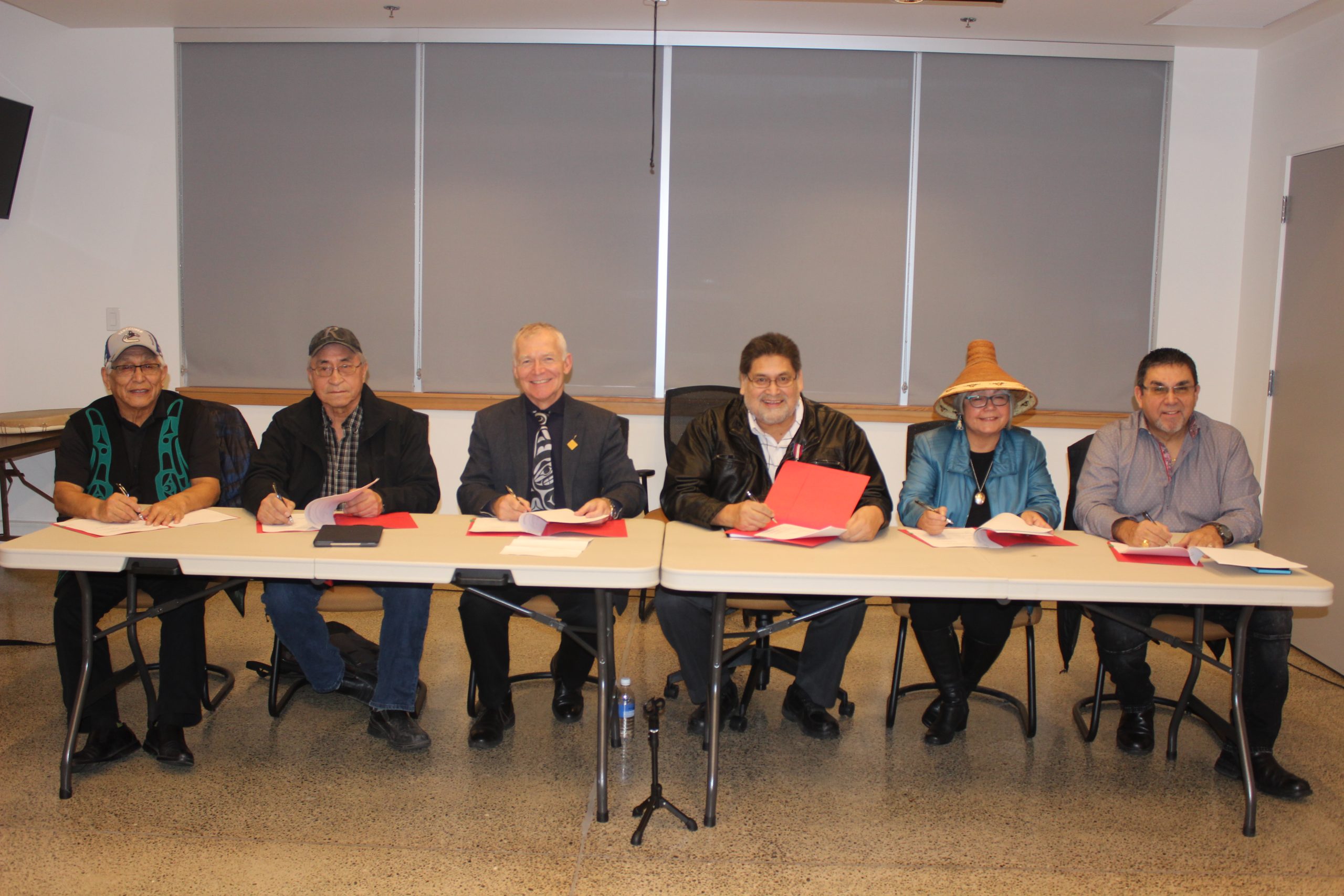
    VICTORIA – British Columbia and the five Maa-nulth First Nations are strengthening and affirming their treaty partnership through a new government-to-government agreement.

    This unique agreement was signed today by the Minister of Indigenous Relations and Reconciliation, and leaders of the Maa-nulth First Nations.

    The government-to-government agreement between B.C. and the Maa-nulth First Nations creates regular forums to discuss, prioritize and collaborate on topics of mutual interest, including land, resource management, and treaty implementation issues.

    “This agreement continues the great, innovative work happening through the Maa-nulth treaty. It outlines ways we can work better together, which is good news not only for Maa-nulth First Nations, but also their neighbouring communities,” said Scott Fraser, Minister of Indigenous Relations and Reconciliation and MLA for Mid Island-Pacific Rim. “Ownership and jurisdiction over their treaty lands and resources is allowing each of the Maa-nulth First Nations to grow and develop their economies and societies in the manner they determine best. Treaties are a powerful foundation, but it takes respectful, ongoing government-to-government relationships to make them effective.”

    Maa-nulth First Nations are important contributors to the economic and cultural life of the west coast of Vancouver Island, and the agreement is another avenue to explore opportunities and ideas. Developing practical and flexible ways to address natural resource, land and treaty issues benefits Maa-nulth citizens, industry and the greater region.

    “Today’s monumental signing that celebrates the government-to-government relationship the Yuułuʔiłʔatḥ Government has with the Provincial Government of B.C. is a positive step to implement the Maa-nulth Treaty. Collectively, we need to revitalize our relationship and work collaboratively on common issues and concerns,” said Yuułuʔiłʔatḥ Government President Les Doiron. “This is an added advantage of a modern treaty government’s place in B.C. and a relationship that needs to be cultivated for all our citizens.”

    “Signing the Maa-nulth Treaty was an important step for our Nations, but it is essential that we continue to work hard to make the most of the opportunities the treaty offers,” said Huu-ay-aht Chief Councillor Robert J. Dennis Sr. “By continuing to build on our relationship with the Province, we show what can be accomplished with true reconciliation.”

    “We view this agreement as one more step towards fulfilling the promise that treaty has created for our people,” said Uchucklesaht Tribe Chief Councillor Charlie Cootes. “We look

    forward to strengthening our relationship with British Columbia through shared recognition and application of mutual respect in our dealings. Our goal, like B.C.’s, is cooperation between our governments to our shared advantage and the benefits to both.”

    “This is an important agreement which will facilitate the implementation of our treaty and help guide us in implementing our Nations’ strategies for moving forward by developing and sustaining a government-to-government relationship with B.C., an essential step in reconciliation.” said Toquaht Nation tyee ha’wilth Anne Mack.

    “The Ka:’yu:’k’t’h’/Che:k’tles7et’h’ First Nations are pleased to enter into this Maa-nulth and British Columbia government-to-government forum agreement,” said Ka:’yu:’k’t’h’/Che:k’tles7et’h’ First Nations Legislative Chief Peter Hanson. “It completes the suite of venues to achieve orderly, collaborative and respectful implementation of the Maa-nulth Treaty in partnership with British Columbia. We truly look forward to our new relationship.”

    The agreement supports improved co-ordination of natural resource development and land management across treaty land and adjacent Crown lands, as well as addressing issues where Provincial jurisdiction applies on treaty land, such as environmental protection, highways, wildlife, or foreshore marine areas.

    It also provides B.C. and Maa-nulth First Nations regular forums to explore new economic development opportunities, and to address issues related to health, education and social development.

    For official press release: Maa-nulth strengthen treaty relationship


  • Nation announces Elder Healthy Home Grant Pilot Project for citizens in Anacla

    Huu-ay-aht First Nations has made taking care of our elders a priority. The Nation must ensure elders have access to the things they need to continue to live a comfortable, healthy life.

    This week, Executive Council passed a motion to create an Elder Healthy Home Grant Pilot Project for Huu-ay-aht elders living in Anacla. The project will be funded until March 31, 2018, and it has a budget to a maximum of $250,000.

    The purpose of the pilot project is to provide one-time assistance to Huu-ay-aht elders in Anacla to make repairs, perform maintenance, and/or make improvements to their permanent, long-term residence that is reasonably necessary to healthy and safe living conditions.

    “Our elders have worked hard to build Huu-ay-aht into the strong Nation it is today,” explains Chief Councillor Robert J. Dennis Sr. “Taking care of our elders is a priority. Our treaty has created many opportunities for our Nation, and we must ensure that our elders see those benefits.”

    The Chief Councillor added that, to avoid conflict of interest, he will not be applying for the program.

    This funding will be offered only once, and it should be used only when all other financial avenues have been exhausted. Funding cannot be used for personal gain or reoccurring costs. If a project is approved, the Huu-ay-aht government will coordinate and pay for the provisions of services and related materials. Should the citizen choose to do the job themselves, the Huu-ay-aht government will pay for the materials. Unless otherwise agreed upon, payment will be made directly to the vendor or person providing the service or supplies.

    Following the completion of the pilot project on March 31, 2018, the policy will be reviewed, and it may or may not be expanded, modified, or continued. The maximum elders can apply for is $20,000 per residence. If the required work exceeds this amount, the work will be prioritized so that the most pressing issues are addressed.

    The following considerations must be made in each case:

    • Huu-ay-aht First Nations will be the last resort payer.
    • Huu-ay-aht will require consent from the owner of the residence where it is not the elder, to make the repairs, maintenance and improvements.
    • Huu-ay-aht will require the owner of the residence where it is not the elder, to provide assurances satisfactory to the Nation that the Elders will be able to stay in the residence for a minimum of two years after the work is completed.
    • Point of contact with the applicant is the Director of Infrastructure and Capital or his or her designate.
    • Infrastructure and Facilities Lead, will work with applicants to complete their application, evaluate the cost and eligibility of proposed repairs, maintenance and improvements, obtain Huu-ay-aht approvals and coordinate the carrying out of the approved expenditures.
    • There will be no retroactive reimbursement to elders for expenses previously paid
    • The period of time between receipt of a completed application and a decision on the application will be no longer than 10 working days.
    • The Executive Director has the sole discretion to provide any required clarification of this pilot project policy and where necessary to establish additional conditions or parameters providing they are consistent with and contribute to the achievement of the purpose of this pilot project policy.

    To be an eligible expenditure, the job must contribute directly to their healthy and safe living conditions. The repairs, maintenance, or improvements may involve:

    • All roofing components, which include but are not limited to shingles, flashings, eaves troughs, chimneys, as well as facia;
    • Building envelope – all of the elements of the outer shell that maintain a dry, heated, or cooled indoor environment and facilitate climate control, as well as wall finishes including exterior/interior painting and washing;
    • Heating systems;
    • Domestic hot water tanks, septic systems;
    • Kitchen facilities such as sink and faucet installations, counter tops and cabinets;
    • Bathroom facilities such as toilets, sinks and fixtures, vanities, tubs and fixtures;
    • Interior floor coverings;
    • All appliances;
    • All structural components related to the actual structure of the house.

    If you have any questions, please contact Stephen Rayner, Director of Lands, Resources, and Infrastructure at 250-723-0100 or Stephen.r@huuayaht.org.  For a copy of the application, click on the link: elder healthy home application. Where there is a disagreement under the pilot project policy, for example regarding the eligibility of a repair, maintenance, or upgrade item, the final decision resides with the Executive Director.


  • Executive Council makes decision regarding distribution to minors

    Executive Council passed the attached motion this morning regarding distributions to minors.
    With respect to making distribution payments to minor citizens, Executive Council has a fiduciary obligation to make decisions in the best interests of each minor citizen. In keeping with this obligation, Executive Council has decided that the Nation will hold funds in trust for minor citizens until they each reach the age of majority (19).
    However, Executive Council recognizes that in some circumstances it will be in the best interests of a minor citizen to allow their parents or guardians to access distribution funds on their behalf in advance of their nineteenth birthday. Decisions about when this is so must be made on a case by case basis.
    The Citizen Development Committee will be responsible for recommending a policy regarding distributions to minors. Executive Council has directed the committee to develop recommendations with respect to those aspects of the policy that relate to the application process for early distributions to minors on an expedited basis and that the committee report back to the Executive Council regarding those recommendations by November 29. An update will be provided to citizens once Executive Council has had an opportunity to consider those recommendations. In order to give time to ensure that the policy is well thought out and can be implemented in a good way, it is expected that it will be in place early in the new year.


  • Cultural name – Kwispaa – chosen for LNG project

    Huu-ay-aht First Nations and Steelhead LNG are pleased to announce that the co-managed LNG project in Sarita has a new name. Following recommendations from the LNG Advisory Committee, Ḥaw̓iiḥ Council has approved the name Kwispaa (Kwis-pa-a) LNG project.

    The traditional name reflects Huu-ay-aht’s elders and its rich history and connection to the land and territory, as well as its stake in this project. Keeping in line with the co-management and in the spirit of reconciliation, Steelhead LNG agreed to change the name of the project.

    Kwispaa means “on the other side,” because it is on the other side of the bay from Nuumaqamis, Huu-ay-aht’s winter village at the mouth of the Sarita River. The Sarita River is a very important site for Huu-ay-aht People. It is the “Heart of the People” and is the most important of 35 rivers and creeks in the Traditional Territory. Sarita is a European place name given by Spanish settlers when they arrived in Huu-ay-aht’s territory.

    Chief Councillor Robert J. Dennis Sr. says that renaming the project Kwispaa respects Huu-ay-aht’s elders and the Nations’ traditional values. The name was discovered by two ethnographic researchers studying the region following a conversation with Robert Sport, historian and speaker for then hereditary chief Arthur Peters.

    The European name has colonial association and reflects an era of assimilation and negative impacts on Huu-ay-aht’s culture and community.

    Naming the project after the site’s traditional and true name demonstrates Steelhead LNG’s commitment to reconciliation, co-management, and their strong relationship with Huu-ay-aht as the Nation and Steelhead develop the project together.

    Huu-ay-aht and Steelhead are working on a place to publicly announce the name change in mid-November.

  • Huu-ay-aht invests in the future with $14.2 million Tribunal award

    This week, Huu-ay-aht First Nations announced how the $14,285,000 IR No. 1 Specific Claims Tribunal Award would be used to work toward self-reliance for all citizens and the Nation.

    The award is the result of a claim Huu-ay-aht filed with the Tribunal in 2011 about logging that took place on former Numukamis IR1 between 1948 and 1969. Huu-ay-aht chiefs petitioned Canada at the time of the logging operations, asserting that the licence should be cancelled, to no avail. In 2014, the Tribunal found that Canada had breached its fiduciary obligations in relation to the way the timber was sold. The Tribunal found that Canada had not acted in Huu-ay-aht’s best interests, had entered into an unlawful arrangement, and that Huu-ay-aht had received far less compensation than it ought to have for its timber. The compensation for these breaches of duty committed by Canada were set by the Tribunal in 2016 and this matter came to a conclusion earlier this year when Canada dropped its appeal of the Tribunal’s decision.

    The allocation made is as follows:
    Invested Wealth Fund – 44%
    Self-Reliance Investment Fund – 22%
    Citizen Dividend – 34%

    This allocation will help to ensure that funds are available to fill the yearly funding gap that will occur beginning in 2021/2022 because of the completion of treaty payments from the Federal government.

    More details on this allocation are currently being shared with citizens at the November Community Engagement Sessions. Citizens will also receive a letter outlining the details on the citizen dividend, the steps that must be taken to receive it, and who qualifies for the funds. The dividend will be $6,000 to each Citizen that is enrolled in the Citizenship Register as of November 6, 2017. This is a one-time payment. Executive Council is hopeful that this dividend payment will help to contribute to Huu-ay-aht citizens of all ages achieving self-reliance.

    To read more details in the letter to citizens, click on this link: Letter to Citizens re: Specific Claims Tribunal Award

    The Government will be fielding calls, but we ask that you wait until November 13, 2017 to contact the Port Alberni Government Office with your inquiries.