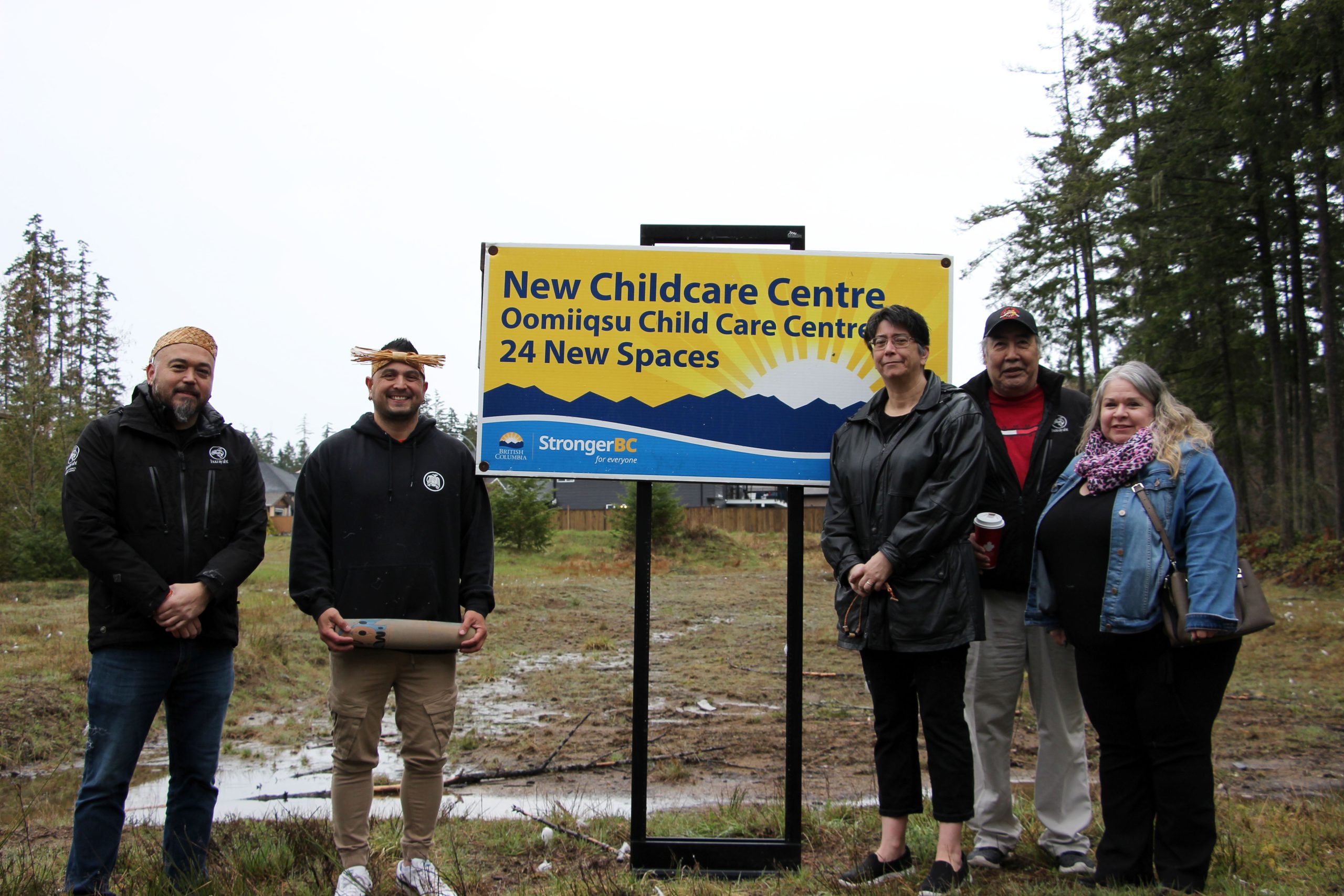
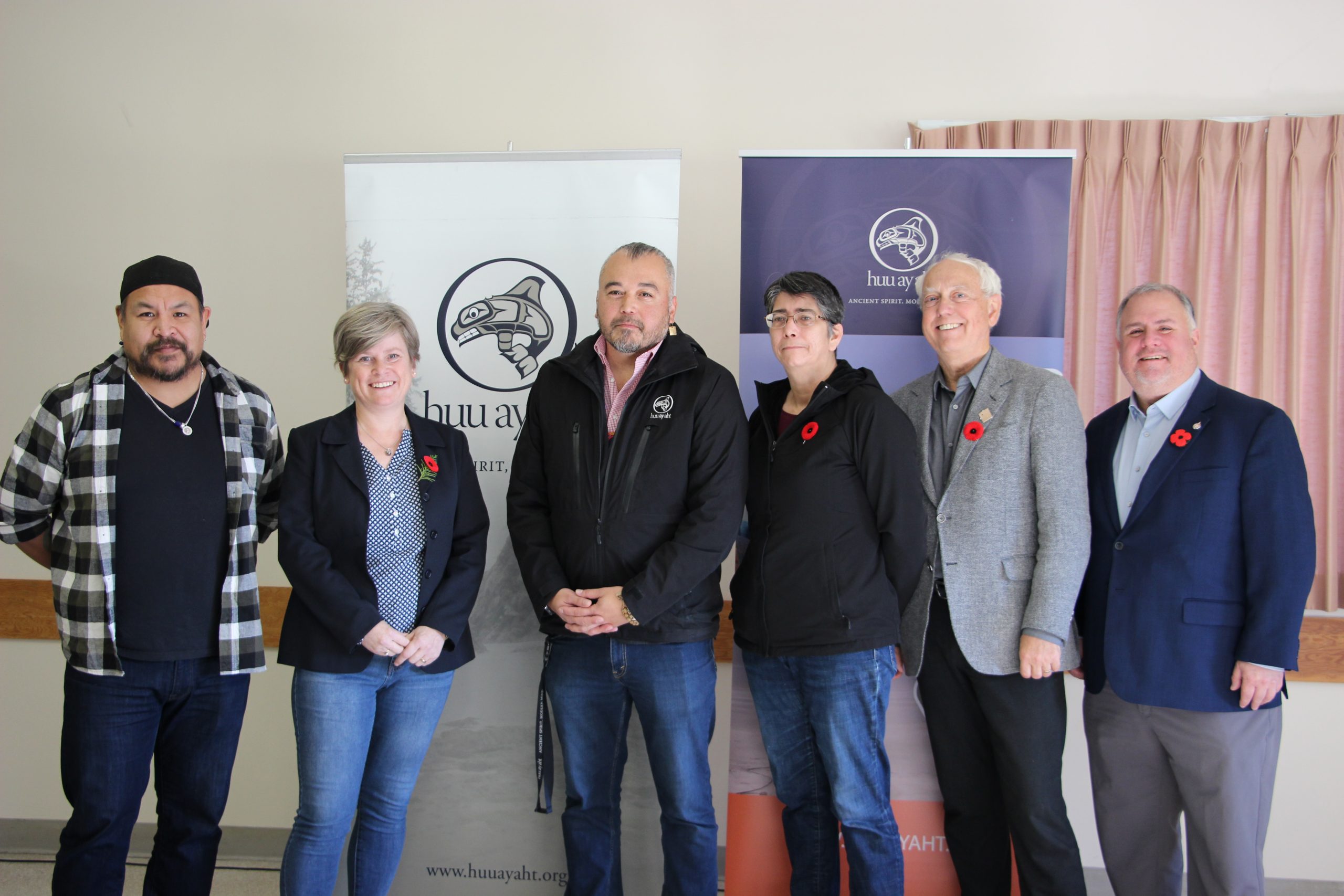
Left to right: Edward R. Johnson (Huu-ay-aht Executive Councillor), Ken Watts (Tseshaht Chief Councillor), Brandy Lauder (Hupačasatḥ Chief Councillor), Jeff Cook (Huu-ay-aht Ḥaw̓iiḥ Councillor), Shannon Zimmerman (Huu-ay-aht Child and Family Wellness Director).
On Monday, April 17, 2023, The Oomiiqsu (Aboriginal Mother Centre) grounds were cleansed before any work begins on the property.
In attendance was Tseshaht Chief Councillor, Ken Watts, Hupačasatḥ Chief Councillor, Brandy Launder, Huu-ay-aht Ḥaw̓iiḥ Councillor, Jeff Cook, Huu-ay-aht Executive Councillor, Edward R. Johnson, Huu-ay-aht Child and Family Wellness Director, Shannon Zimmerman.
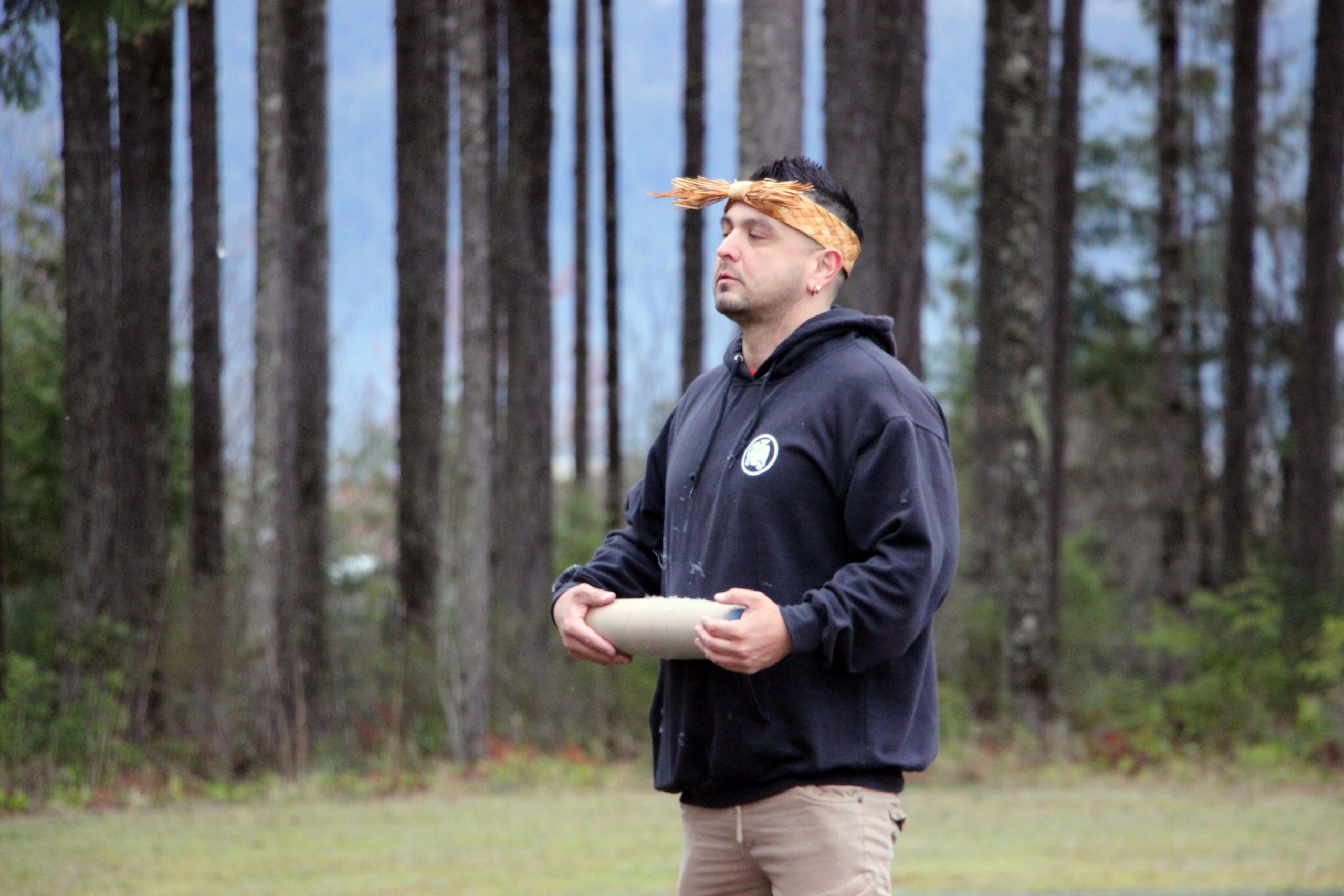
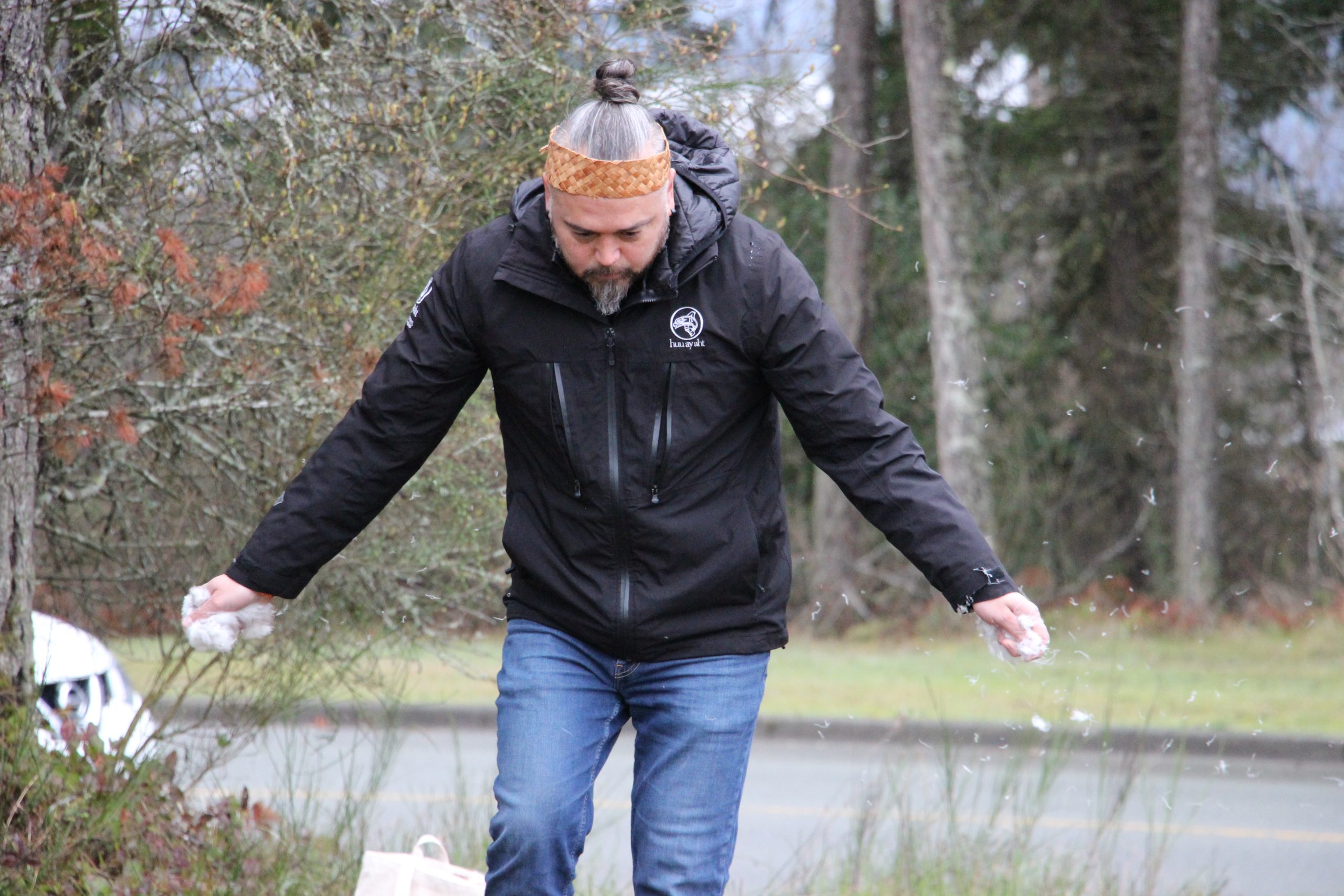
Tseshaht Chief Councillor, Ken Watts chanting a prayer to cleanse the Oomiiqsu property.
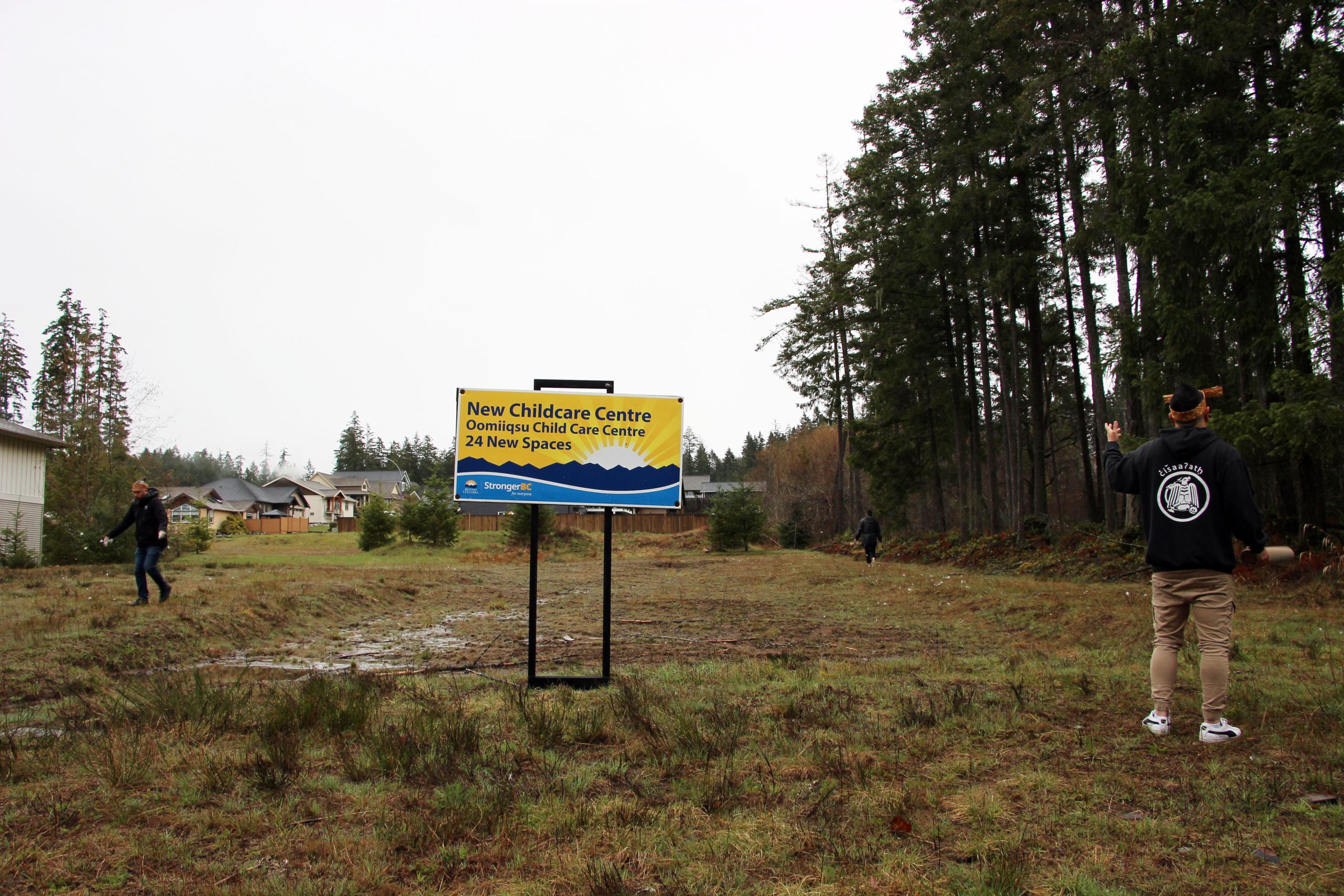
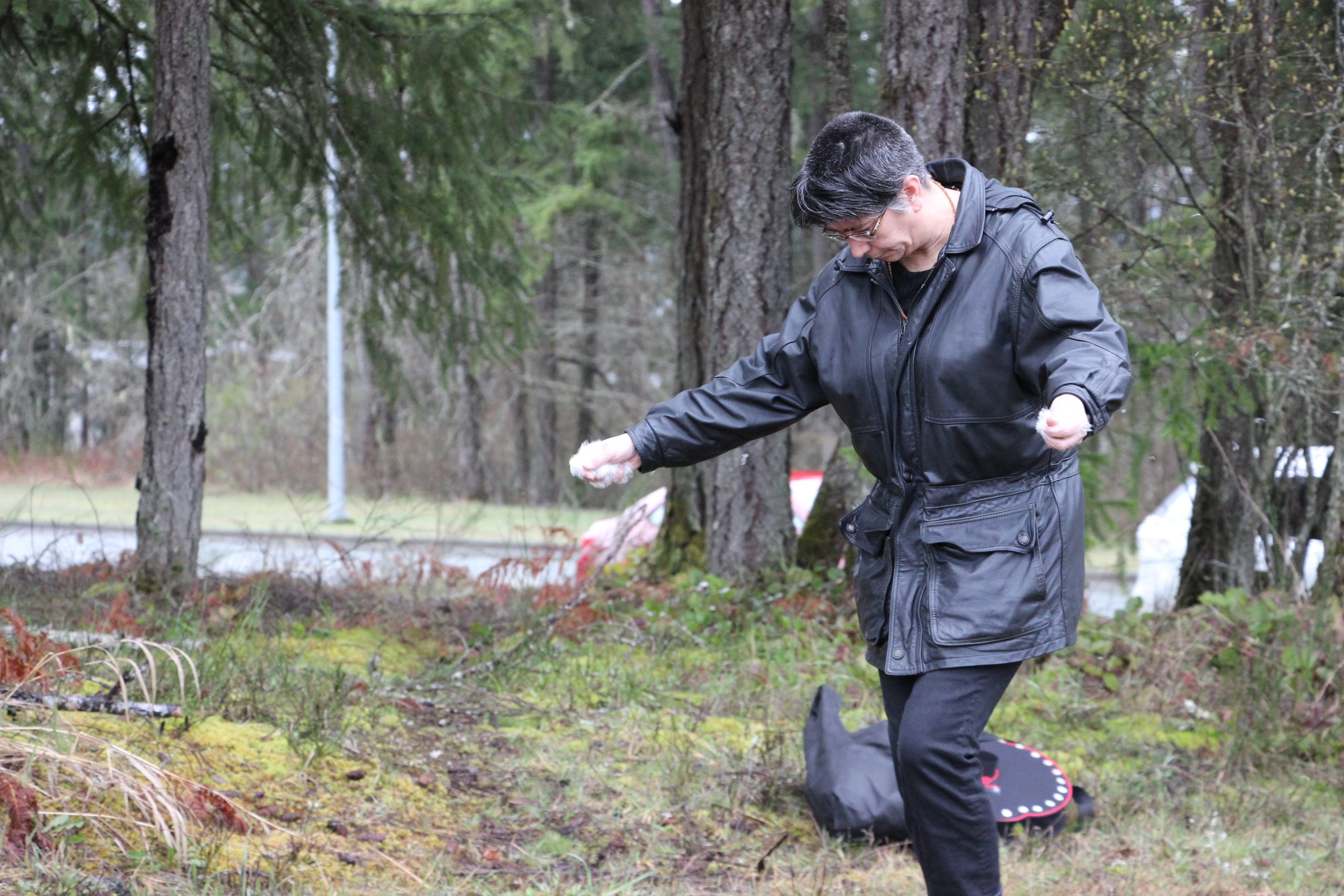
Together, they sent prayers up to the ancestors as they spread eagles down over the property where the Oomiiqsu will be located. In first nation culture, doing this ceremony cleanses the land before important business happens.
Site prep work started following the ceremony, and the ground breaking is expected to happen in May 2023.
Ken Watts, Brandy Lauder, Edward R. Johnson cleansing the land where Oomiiqsu will be built.
Hupačasatḥ Chief Councillor, Brandy Lauder cleansing the Oomiiqsu lands with eagle down.
Huu-ay-aht Executive Councillor, Edward R. Johnson cleansing with Oomiiqsu lands with eagle down.
Resources:
In accordance with the Social Service Panel Report (2017) see recommendations 26 (work to establish a center modelled on the Vancouver Aboriginal Mothers Center): Social Service Panel Report
In accordance with the Social Service Evaluation (2020) areas of focus – Huu-ay-aht to secure operational funding for the Oomiiqsu Mother Centre. Refer to: Social Service Evaculation Report
Huu-ay-aht has secured a location, and funding to build and cover initial operating costs of the Oomiiqsu in partnership with the Province. Refer to:
Huu-ay-aht Child and Family Wellness team invites Huu-ay-aht families (and those caring for Huu-ay-aht children) to learn and grow with Brad and DeeAnna Dennis as they present the Thrive Together Family Workshop over three days (March 27-29, 2023).
Brad and DeeAnna Dennis have invested over 20 years in developing a thriving family life by interweaving their Christian faith in Creator God with Huu-ay-aht teachings. This process has involved decolonizing their Christianity, learning from their Huu-ay-aht ancestors and using the tools they have developed in their professional practice as mental health professionals with children and families. Their workshops are designed to meet the needs of people with various learning styles. So they use stories, interactive exercises visuals, and scientific research.
Journey with Brad and DeeAnna through topics including; healthy roots of self care, strong trunk of marriage & community, and fruit bearing relational parenting.
When: March 27 – 29, 2023
Where: Port Alberni Government Office (4644 Adelaide St.)
Time: 4:30 – 7:30 p.m.
This workshop will be held over 3 evenings. Dinner, accommodations for 3 nights, and childcare will be provided.
For questions, please contact Chris Pearson at christine.p@huuayaht.org or 250-723-0100.
From left to right: Ed Ross (Tseshaht Council Member), Josie Osborne (Minster of Land, Water, and Resource Stewardship and MLA for Mid-Island-Pacific Rim), Edward R. Johnson (Huu-ay-aht Council Member), Brandy Lauder (Hupačasatḥ Chief Councillor), Murray Rankin (Minister of Indigenous Relations and Reconciliation, Attorney General and Minister of Housing), Gord Johns (MP Courtenay—Alberni).
PORT ALBERNI – Huu-ay-aht First Nations and B.C. are celebrating the creation of the Oomiiqsu (Aboriginal Mother Centre), a new housing, support and child care centre that will help Indigenous women and children on the west coast of Vancouver Island.
“Huu-ay-aht has turned over many stones to reach this point of having a mother centre,” said Edward R. Johnson, Huu-ay-aht Councillor. “Through the voices of our citizens in the Social Services Report, it is apparent that Oomiiqsu is going to create a positive impact to Huu-ay-aht families and children in preventing the traumas that many families have had to face. Oomiiqsu is going to be a place to bring children home, where mothers and children will feel safe, healthy and connected, and they will be able to look back and tell many wonderful stories.”
As part of Huu-ay-aht Social Services Project formed in 2017, 30 recommendations were created in the report “Safe, Healthy and Connected: Bringing Huu-ay-aht Children Home.” Oomiiqsu is a response to recommendation 26.
Oomiiqsu, meaning mother, is an Indigenous-led model of care developed by Huu-ay-aht in consultation with its members. The two-storey transition housing, child care and support centre will be managed and operated by the Huu-ay-aht government’s Child and Family Wellness Department. The centre will provide a safe and culturally appropriate home for as many as 48 mothers and children leaving violence or abuse, facing mental-health and addictions challenges, poverty or other trauma.
“This partnership between the Province and the Huu-ay-aht First Nations will make an important difference on the west coast of Vancouver Island, where many communities are remote and provide few options for mothers and their children in need,” said Murray Rankin, Minister of Indigenous Relations and Reconciliation, and Minister Responsible for Housing. “At Oomiiqsu, they will find stability, security and access to support in a way that works specifically for the Nuu-chah-nulth people. I commend the leadership and staff of Huu-ay-aht First Nations for creating this innovative opportunity to work together on these much-needed new transition homes.”
The centre will have private bedrooms and washrooms; shared living, kitchen and dining spaces; and laundry facilities. Residents will have access to on-site child care that will include eight spaces for children as old as three and 16 spaces for children 30 months to school age. The Huu-ay-aht First Nations’ Child and Family Wellness Department will have office space on the first floor of the building.
Huu-ay-aht will operate the building, providing support services 24 hours a day, seven days a week, to Indigenous mothers experiencing violence. Wraparound supports provided by the Province will give families the best chance of staying together and will help address systemic factors leading to the disproportionate number of Indigenous children in care.
The project is made possible thanks to a partnership between the Huu-ay-aht and the B.C. Government. The Province is investing as much as $5 million for Huu-ay-aht First Nations to cover initial operating costs for the Oomiiqsu Mother’s Centre. BC Housing is investing approximately $10 million through the Building BC: Women’s Transition Housing Fund and will provide $88,000 in annual operating funding. The Ministry of Education and Child Care is providing nearly $800,000 for child care spaces.
By honouring First Nations culture and focusing on reviving familial, community and cultural connections, this new model of care is an essential part of reconciliation. The centre will open for women and children in summer 2024.
Quotes:
Josie Osborne, MLA for Mid Island-Pacific Rim – “Oomiiqsu is a unique, Indigenous-led approach to family services that will make Huu-ay-aht and other communities along the west coast of Vancouver Island stronger and healthier. The centre is an opportunity to support Huu-ay-aht’s vision to advance child welfare matters and support resilient families and children.”
Katrina Chen, Minister of State for Child Care – “Oomiiqsu will provide Indigenous-led child care and wraparound supports and services that focus on healing and strengthening families. For many vulnerable families and those dealing with various trauma – notably mothers – being able to access culturally appropriate child care in a safe space is the peace of mind needed to continue on their healing journeys, and Oomiiqsu offers this holistic approach.” Quick Facts: • Oomiiqsu is modelled after the Vancouver Aboriginal Mother’s Centre, which was established in 2002 in Vancouver’s east end. • Huu-ay-aht First Nations is an Indigenous community located on the west coast of Vancouver Island. It is a part of the Nuu-chah-nulth Nation, formerly called the Nootka. • Huu-ay-aht is a party to the Maa-nulth Final Agreement, a modern treaty that grants its five member Nations constitutionally protected self-government, as well as ownership, control and law-making authority over their lands and resources. • As with all projects for women and children leaving violence, the address of this project has not been disclosed for safety reasons.
Huu-ay-aht First Nations is pleased to release an independent evaluation of the Social Services Project, launched in 2017, that shows great successes have been achieved in the first three years of the project.
Huu-ay-aht contracted an independent party to conduct an evaluation of the project to determine the effectiveness of the project. The goal in 2016, when the Social Services Panel began its work, was to ensure that all Huu-ay-aht children grow up safe, healthy, and connected to their Huu-ay-aht home, culture, and values.
The report will serve as a benchmark against which future evaluations will be measured. This represents the first evaluation of Huu-ay-aht’s Social Services Project since the 30 recommendations were finalized in 2017.
“The results of this evaluation prove that there is a way forward. Huu-ay-aht’s vision is coming to fruition through ensuring their vision is acted upon with expertise, planning, and frontline workers,” said Kim Baird, Social Services Panel member and advisor. “Of course, another key ingredient for success has been funding assistance from government partners. The reconciliation of Huu-ay-aht families is integral to the future sustainability of Huu-ay-aht First Nations.”
Feedback came from 169 Huu-ay-aht citizens, Community Services and Child and Family Wellness team members, directors for Huu-ay-aht’s Community Services and Child and Family Wellness department, the acting executive director, and members of Executive Council and Social Services Task Force. The COVID-19 pandemic had a major impact on the evaluation process, as in-person engagement was not possible and online surveys were conducted instead.
“It is important that we hear what is important to our people and those who are helping to raise our children,” explained Huu-ay-aht Councillor Edward R. Johnson, adding how thankful he is to the citizens who participated. “We are pleased to have heard from so many people and this will help us shape the program moving forward to ensure we are meeting the needs of the community so we can achieve our goal of bringing our people home and keeping our children safe and connected to their nation.”
As a result of the survey, 26 areas of focus were identified. Highlights include:
Securing Oomiiqsu (Mother Centre) funding
Affordable housing
Equipping staff with the tools they need to do their job in a balanced, healthy way
Focus on culture, language, and traditional foods
Communication
Ensuring all demographics (youth to elders) are being served
Focus on addressing violence, physical health, mental and emotional health, and the tools needed to ensure citizens can lead a healthy lifestyle
“This interim assessment is an important step in implementing the Huu-ay-aht vision for bringing and keeping children in the fold of family and community love, care, and culture.” Maegen Giltrow, Social Services Panel member and legal counsel. “It is very rewarding to see that 64 per cent of Huu-ay-aht citizens who responded said they felt their family’s safety had seen some or great improvement from the Huu-ay-aht Social Services Project over the previous year. But the assessment is also an important guide to the substantial work that lies ahead.”
Moving forward, the results of this evaluation will guide the program and service delivery to help promote mental health and emotional well-being for Huu-ay-aht citizens of all ages, gender, and sexual orientation. The team will prioritize strengthening families by ensuring all additional parenting and caregiving support is available through Oomiiqsu and other programs and services.
“It is encouraging to see the results of this evaluation as it shows we are on the right track,” explained Tayii Ḥaw̓ił ƛiišin (Head Hereditary Chief Derek Peters). “We have to continue to move forward with our Ancient Spirit and Modern Minds, while honouring our sacred principles of ʔiisaak (utmost respect), ʔuuʔałuk (taking Care of), and Hišuk ma c̕awak (everything is one).
Huu-ay-aht First Nations is pleased to announce it has been awarded $763,924.33 from the Province of British Columbia’s Childcare B.C. New Spaces funding.
This grant will allow the Nation to create 24 new spaces at the Oomiiqsu Childcare Centre, which will be housed at the proposed Oomiiqsu Mother Centre in Port Alberni. The site will be located at 4305 Kendall Ave once complete and offer services to Huu-ay-aht and other Nuu-chah-nulth families.
The Oomiiqsu Childcare Centre will be an integral part of Oomiiqsu Mother Centre, and priority for the spaces will be given to children residing in centre. Of the 24 spaces, eight will be for children 36 Months and Under and 16 will be for children 30 Months to School Age.
“We are grateful to receive this grant from the province because it enables us to move forward on this exciting project,” says Huu-ay-aht Councillor Edward R. Johnson. “This has been a collaborative effort from the start. I am very thankful for the team and am truly honoured to have witnessed this journey. It is so important to our Nation to bring more of our children home as that honours our Ancient Spirit and Modern Mind.”
Elders and other community members will teach Nuu-chah-nulth language and prepare traditional foods with the children. Traditions, ceremonies, songs, drumming dance and crafts will be shared and taught by Huu-ay-aht First Nations Elders/community members and staff as well as other Nuu-chah-nulth Nations.
“We honour our Ancient Spirit and Modern Mind when we find ways to keep our youth safe and in an environment that nurtures traditional learning at all ages, just as our ancestors taught us,” explains Huu-ay-aht Tayii Ḥaw̓ił ƛiišin (Head Hereditary Chief Derek Peters). “By doing so, we are following our Sacred Principles of ʔiisaak (Utmost Respect), ʔuuʔałuk (Taking Care of), and Hišuk ma c̕awak (Everything is One).”
Mothers will be welcome at the centre and strongly encouraged to participate in the childcare program. Parenting support will be offered as well, and programming will support children and their mothers to build strong cultural identities that will connect them to their larger families and communities.
The land on Kendall Avenue has been purchased by BC Housing, and a Rezoning Application has been submitted to the City of Port Alberni. A public hearing was held on May 13. There were no objections voiced at the meeting, and the matter will be addressed by Port Alberni City Council at a future meeting. Construction is set to begin in April 2021 and the Oomiiqsu Childcare Centre will open in September 2023.
September 30 marked a day Huu-ay-aht celebrates the coming home of six Huu-ay-aht children. After hard work and dedication of everyone involved, the children are now in the care of their Huu-ay-aht family.
Huu-ay-aht staff and executive council members, representatives of the ministry, and families, gathered on Zoom to welcome the children back into the care of their family and acknowledge everyone’s work along the way to make it happen.
This event was an opportunity to mark the success achieved through the Social Services Project. It highlights the importance of the work the Child and Family Wellness Team is doing to bring Huu-ay-aht children home.
“It was a wonderful day – seeing the results of our social services project at work,” said Executive Council member Edward R. Johnson. “The team from the Child and Family Wellness Office is doing a wonderful job in achieving our goals, where our Huu-ay-aht children will grow up safe, healthy, and connected to our home and culture/values guided by our traditions and our nananiiqsu.”
In 2017, the Huu-ay-aht First Nations Social Service Project was brought to life. Within this project, lay 30 recommendations that Huu-ay-aht will implement to keep families safe, healthy, and connected to their nation, while also bringing children home.
This project has been active for three years and in that time, Huu-ay-aht has implemented 28 of those recommendations (almost 29 – Oomiiqsu Mother Centre in the process). In that time, 28 Huu-ay-aht children have been brought home.
Grandparents, Wayne and Ida Seitcher welcome home Meredith, Gordan, Rose and Marley. Mother Christyl Smith welcomes home daughters Aurora and Alexya.
“Congratulations to these two families who persevered and worked hard at getting the children back into their care” said Chris Pearson, Huu-ay-aht Protection Support Worker. “They are the reason we do the work that we do, I am humbled and honoured to have been a part of their journey, and I wish them all the very best for the future.”
Christine Pearson and Kerry-Ann Collinge worked closely with the families and ministry workers and thanked everyone for their hard work and attending the welcoming home ceremony.
Kerry-Ann said “What we are witnessing here today is healing for these children, families, and community”.
To contact Child and Family Wellness please phone 778-419-1013 or email Director of Child and Family Wellness, Shannon Zimmerman at Shannon.z@huuayaht.org. You can also find more information about the department at www.huuayaht.org.
For after-hour protection support, please contact 250-731-6999. Call this number only if you have received a call from Child Protection Services (i.e. MCFD/Usma or other delegated agencies). Anything not related to this matter will be followed up during office hours.
Offering support and healing from multi-generational trauma is a key focus that came out of Huu-ay-aht’s independent Social Services Panel’s work. In the final report one of the recommendations was to work to establish a centre modeled on the Vancouver Mother Centre.
“Building a road to healing the effects of multi-generational trauma will be of fundamental and central importance to bringing Huu-ay-aht children ‘home’ and keeping them safe, healthy, and connected with Huu-ay-aht community and culture. This healing must be done family by family and collectively as a Nation.” (Social Services Project p. 24)
Huu-ay-aht First Nations and the Port Alberni Mother Centre Society has been working with B.C. Housing to develop an Aboriginal Mother Centre, Oomiiqsu, in Port Alberni (Recommendation 26 of the Social Services Project). Oomiiqsu, which means mother in Nuu-chah-nulth, is a unique, creative, and culturally appropriate approach to keeping families together, while providing them with the necessary guidance and tools to not only prevent children from entering care, but also for the families to flourish once outside of Oomiiqsu. Mothers and children (12 and under) will live in Oomiiqsu and receive wrap-around supports to address ongoing safety concerns from Usma (DAA) and/or Ministry of Children and Family Development.
Oomiiqsu will house multiple programs and services to support Huu-ay-aht and other Nuu-chah-nulth families:
12-unit residential program for mothers and their children, ages 9-12
Four second-stage housing units
Oomiiqsu Child Care Centre
Office space for the Child and Family Wellness Department
Land has been purchased by BC Housing at 4305 Kendall Avenue and design plans for Oomiiqsu and Oomiiqsu Child Care Centre are complete. The Nation is still finalizing the plan for the centre, and we look forward to sharing this rendering with everyone once plans are finalized.
Further progress on the project is subject to other approvals and funding from partners, but Huu-ay-aht is committed to making this centre a reality. As we move through the initial steps, we will continue to offer regular updates when they are available.
Huu-ay-aht made a rezoning application to the City of Port Alberni on September 14, 2020. Signage notifying the public of this rezoning will be posted at the proposed site within 15 days to notify the public.
This is an exciting project for Huu-ay-aht and the Alberni Valley, and we look forward to sharing more information from you as the plan progresses.
Five babies born in the past two years were celebrated and welcomed into the Huu-ay-aht community on Friday, May 4, in a ceremony in Port Alberni.
Although absent from the ceremony, an additional four babies were also celebrated and welcomed. Huu-ay-aht’s nine new babies are:
Violet Daisy Johnson (mother Latisha Johnson)
Charleigh Rose Danielson (parents Miles Danielson and Quinn Turgeon)
Margaret Johnson (parents Keira Lucas and TJ Johnson)
Reyna Jack (parents John and Crystal Jack)
Emily Marie Violet Cunningham (parents Ashley Bodaly and Colin Cunningham)
Evan Mack (mother Natasha Mack)
Twins Cassandra and Marissa Dennis (parents Philip Dennis and Katherine Frank)
Jordan Rayner (parents Marina Rayner and Noah Plonka)
(Pictured – L to R) Clara Clappis and Emily Cunningham, Latisha and Violet Johnson, Keira Lucas and Margaret Johnson, Quinn Turgeon and Charleigh Danielson, Ezri, Reyna, and Crystal Jack
Huu-ay-aht’s Tayii Ḥaw̓ił ƛiišin (Derek Peters) opened the event, followed by a welcoming song and a ceremonial wrapping of the babies. Each baby was wrapped in a blanket, symbolizing all the things a baby needs – food, shelter, love, community, culture, and more. Edward R. Johnson Jr. called each family to stand beside him at the front of the room, as he spoke of the baby’s family history and its roots.
“It’s important to understand where everybody comes from and making connections to our family,” he said. “Understanding these connections allows you to recognize who your relations are and where you come from.”
The room was full of friends, family, and community members witnessing these histories. Many of the family members also spoke of the ties between different Huu-ay-aht families and how everyone is connected.
The ceremony embodied ʔuuʔałuk, ensuring the success of our families for generations to come. These new babies are supported physically, spiritually, emotionally, and mentally, and they will grow up healthy, strong, and connected to their families and to Huu-ay-aht First Nation.
Lunch was served after the ceremony, followed by drum-making for the babies.
ƛiišin closed the event, speaking about how it takes a community to raise a child, and therefore we must start by understanding who they are and where they come from.
Huu-ay-aht First Nations is very pleased to announce that, almost two months after she gave birth to her new daughter, a new mother is now able to return home to Port Alberni with her baby.
The Nation received word on Wednesday afternoon that Provincial Court of British Columbia Judge Flewelling ruled in favour of the mother (LS), stating that the baby must be returned to the custody of her mother no later than Saturday, March 17, 2018. The mother and child will reside in Port Alberni with Huu-ay-aht family. The Nation will offer ongoing supervision and support to both mother and child when needed. The mother will also participate in recommended programs and services, including Nuu-chah-nulth and Huu-ay-aht specific programs.
“This judgment provides strong recognition of the importance of the maternal/infant bond, and the obligation upon the Ministry to fully consider the supports that are available to keep mom and baby together rather than simply removing the infant from the mother,” explains Maegen Giltrow, counsel for the mother and Huu-ay-aht. “This is an especially important recognition of the role of the Huu-ay-aht community in supporting one of its citizens as she moves into the role of new mother.”
The Court said specifically that the Director of Child, Family and Community Services “must establish that she has been active and diligent in attempting to find other alternatives to removing a child before a final determination that there are no other less disruptive means of protecting the child” (para. 94), and that the “least disruptive means” must be viewed from the child’s perspective, which includes that the child be “spared as little disruption and emotional distress as possible” (paras. 87 and 95). The Court pointed specifically to evidence of the harm arising from disrupted attachment for newborns (paras. 38 and 98).
For almost two months, the future of this child has been in question, after the Ministry of Children and Family Development apprehended the baby girl only three days after she was born, without sufficient reason. Since that time, the mother has been living out of a motel room in Courtenay BC, more than 100 kilometres away from her community in Port Alberni, in order to have access to her baby. Following a BC Supreme Court Ruling in mid-February (2018 BCSC 255), the mother was given more access to her child for bonding and breastfeeding purposes. Although pleased by that victory, Huu-ay-aht First Nations continued to press in Provincial Court that being returned to her mother was what was in the child’s best interest.
The Court held that “In Courtenay, LS does not have the supports that she needs from her own community and family and which are available to her in Port Alberni. That support and assistance are essential for her to properly care for her baby” (para. 89).
“This ruling helps establish a solid foundation for mom and baby to begin a happy and healthy life together, with support of family and community,” explains Huu-ay-aht Councillor Sheila Charles. “With this strong foundation, this baby will have every opportunity to grow up safe, supported, and loved by both her mother’s and father’s First Nations.”
This ruling supports the approach the Nation has taken in implementing the 30 recommendations from an independent Social Services Panel on how to “Bring Our Children Home” and stop the cycle of breaking Huu-ay-aht families up into the foster care system (Full report: https://huuayaht.org/social-services-project/ ). Everyone involved in making this a reality hopes this is just the beginning, and that the Nation will eventually realize its dream of having no Huu-ay-aht children in care.
“Huu-ay-aht has a strong and accountable plan for ensuring our children grow up safe, healthy, and connected with their Huu-ay-aht family and culture. We can’t do it alone,” adds Councillor Charles. “We need the provincial and federal governments to do their part. Today’s decision is helpful in setting clear standards to ensure Indigenous communities are part of the planning for our children.”
Today, Huu-ay-aht First Nations declared the treatment of Huu-ay-aht children by the Province of British Columbia a public health emergency.
“Despite the provincial government saying it is a priority, we continue to see the number of Huu-ay-aht children in care increase,” says Huu-ay-aht Chief Councillor Robert J. Dennis. “The time for endless talk is over – we demand British Columbia take action. It’s time for the province to cooperate and do its part – this is a public health emergency.”
Since August of 2017, Huu-ay-aht has started implementing the 30 recommendations of the Huu-ay-aht First Nations Social Services Panel Report. These recommendations aim to reduce the number of children in care and ensure Huu-ay-aht children grow up safe, healthy, and connected to their home, culture, and values.
To date, Huu-ay-aht has funded the project on its own, paying more than $600,000 of the $1.8 million per year required to implement the recommendations. However, the independent panel made it clear Huu-ay-aht cannot be expected to go it alone. Successful implementation of the the Panel Report recommendations is a shared responsibility and depends on the provincial and federal governments providing immediate funding, cooperation and jurisdiction to address this emergency.
“We have a plan that can bring the number of children in care to zero, but we have not received support from either the provincial or federal governments. When we started working on the recommendations from our Social Services Panel, our Nation had 34 of our 220 children in care, and 25 were in non-First Nations homes. That number is now 47, with 36 in non-First Nations homes,” Chief Dennis says. “I was shocked to hear it was increasing. There is a better way, and we need the province and federal government to immediately do their part to find a solution to this crisis for all First Nations communities.”
The need for immediate action was highlighted this week when lawyers for the Ministry of Children and Family Development (MCFD) sought to reduce the access the BC Supreme Court had earlier ordered to ensure that one Huu-ay-aht mother and baby could sustain breastfeeding and their maternal/infant bond. Huu-ay-aht challenged the province after it removed a newborn without warning from its mother in a completely unwarranted manner. Huu-ay-aht First Nations had been forced to seek emergency relief from the Supreme Court to ensure the maternal/infant bond was not irreparably harmed while they were forced to wait for Ministry and court processes to unfold.
Chief Dennis says, “This case is a clear example of everything that is wrong – this system is broken.”
In a recent article in the Globe and Mail, representative for Children and Youth Bernard Richard, who has read all the files connected with the case, including those not publicly available, said the Ministry’s handling of this case “is egregious and awful,” “reeks of paternalism,” and “raises concerns about systemic racism.”
Such an approach to child welfare by MCFD persists, despite solemn promises from the provincial NDP government to improve the child-welfare system.
“In contrast to this recent apprehension of the newborn, we were able to place another child requiring care in a Huu-ay-aht home due to the quick and ongoing implementation of the Panel’s recommendations,” says Chief Dennis. “While we strive to keep families together, at least in this case, we were able to find the best solution for the child – one that ensures continued access to the child’s own family, culture, traditions, and land.”
The Huu-ay-aht home that was able to help this child was one of the extended family homes that Huu-ay-aht had offered to MCFD to assist the mother and newborn at issue in the Supreme Court ruling. However, MCFD would not consider or accept this home as an option, without explaining why not.
Chief Dennis points out that both the federal and provincial government say they want to keep First Nations families together and provide better supports to keep children out of care. But, the reality is the number of children in care continues to increase.
Huu-ay-aht First Nations expects a full response to this public health emergency at a meeting with MCFD officials on March 15, 2018. Huu-ay-aht also intends to meet with the federal government on this topic next week. At these upcoming meetings Huu-ay-aht expects the province and federal government to provide Huu-ay-aht with immediate funding, cooperation and jurisdiction to address this emergency.