The ACRD has begun planning for evacuation routes as part of the plan with boundaries including Huu‐ay‐aht First Nations lands. The project has been awarded to Calian Group Ltd.
Calian Group Ltd. has requested citizen input through an online evacuation procedure survey. The survey is open until October 21, 2022, and all citizens and residents of Anacla are encouraged to complete the survey to help Calian understand what an emergency evacuation may look like for you and your family. Survey Link
The project boundary includes:
• Bamfield & Long Beach Electoral Areas in entirety,
• Huu‐ay‐aht First Nations lands,
• Toquaht Nation lands,
• Uchucklesaht Tribe lands,
• Yuułuʔiłʔatḥ lands.
More information about the project and funding announcement can be found on the BC Government website.
Since 2018, The Association of Wetland Stewards for Clayoquot & Barkley Sound and Huu-ay-aht First Nations have been working together to protect the toad population at Frederick Lake. Over the years, they have taken steps together to protect important toad habitat close to the lake. When Wetland Stewards heard about the Bamfield Main Road Resurfacing Project, they saw another opportunity in protecting connections between habitats, the lake, and surrounding forests by installing wildlife tunnels.
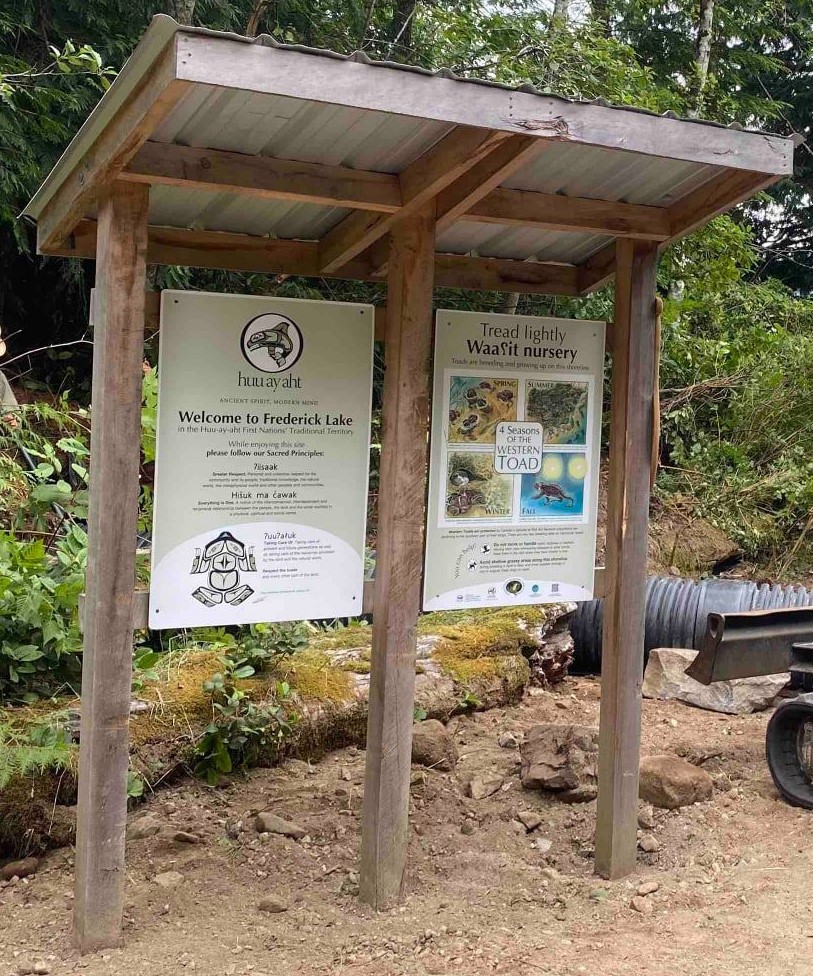
Their first project was installing educational signs and temporary barriers to protect toadlets from being trampled on the north shore of the lake where they emerge in high numbers. Toadlets are baby toads that have just transformed from tadpoles. They come ashore, spend several weeks close to the water, then disperse into the surrounding forest. It’s easy to trample them unintentionally because they are so tiny and difficult to see.
Wetland Stewards worked with Huu-ay-aht Lands and Natural Resources staff to design the educational signs for the site. Edward R. Johnson designed a welcoming sign for those visiting Huu-ay-aht traditional territory with encouragement to follow Huu-ay-aht sacred principles while visiting the site. The sacred principles are ʔiisaak (greater respect), ʔuuʔałuk (taking care of), Hišuk ma c̕awak (everything is one).
In 2021, Wetland Stewards and Huu-ay-aht First Nations took further steps together to protect the toadlets by installing permanent barriers, placing logs, and planting native vegetation. This took place at the end of the road that provides access to the water pump that supplies water to Poett Nook Marina and Sarita log sort. Huu-ay-aht First Nations provided a bobcat and operator (Don Prevost) and labourer (Alec Frank) for several days to complete this task. To further support the project, Huu-ay-aht Forestry LP provided concrete blocks, rocks, and gravel for the barriers, Stan Coleman (Forestry Advisor, Rocky Point Forest) provided time to help coordinate the delivery of those materials, and the BC Ministry of Transportation and Infrastructure provided the toadlet barrier material.
Planning for the toad tunnels under the Bamfield Main Forest Service Road began in spring of 2021. Toadlets get killed crossing the roads that surround Frederick Lake when they disperse into the surrounding forest. Adult toads get killed crossing the roads when they migrate back and forth to breed at the lake each spring.
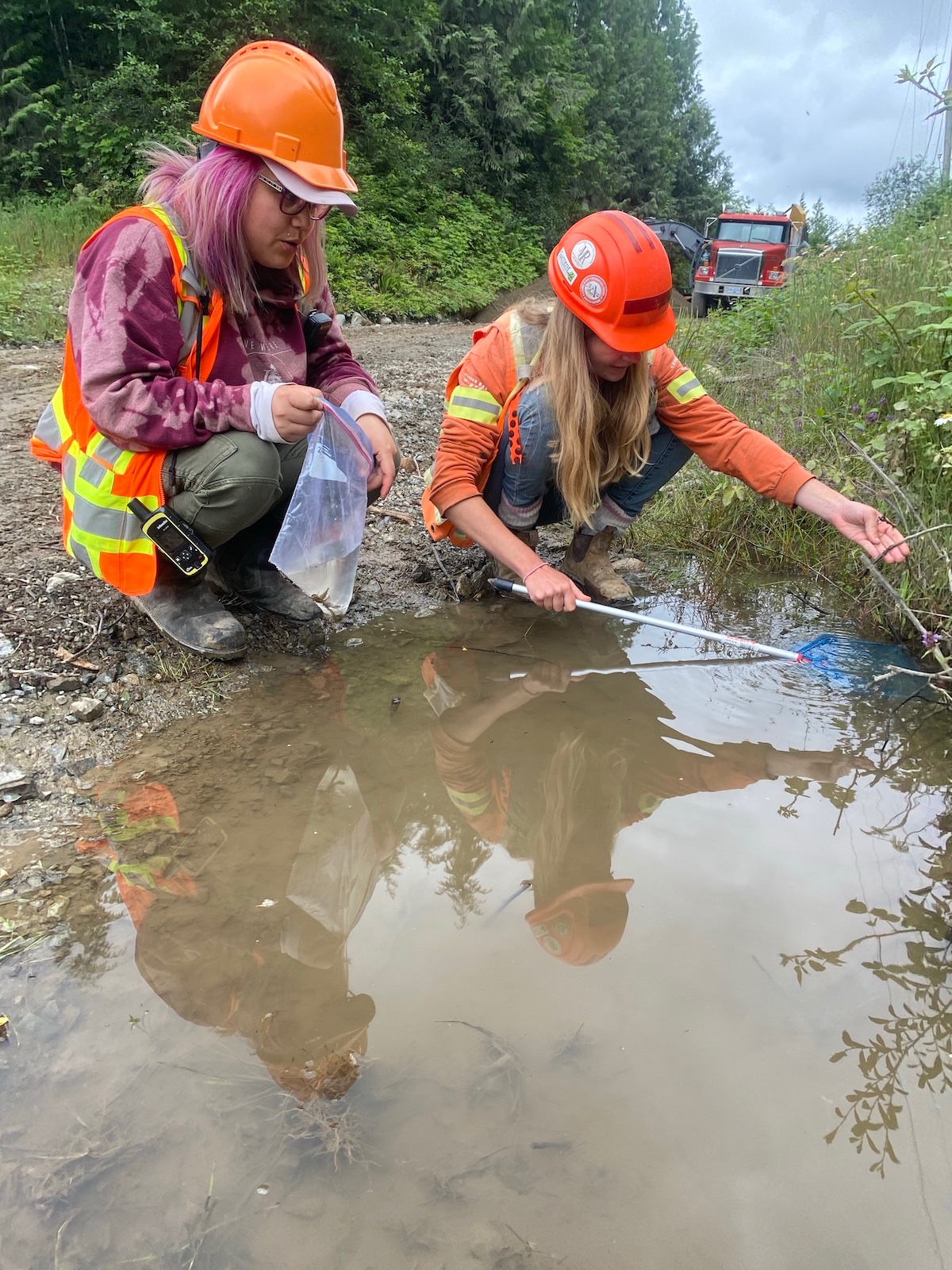
To determine where toadlets and toads are in danger, former Huu-ay-aht staff, Katie Turner, conducted surveys to document locations where toads and other amphibians cross the Bamfield Main. Participants in these surveys were The Wetland Stewards trained technicians, the Huu-ay-aht Watershed Renewal Program staff, Huu-ay-aht Lands and Resources Department staff, and several volunteers from the community of Anacla and Bamfield.
The surveys happened during the migration periods in spring 2021 and 2022 and fall 2021. They spent 14 rainy nights doing these surveys per period for a total of 42 nights. Crews walked 2 km on the Bamfield Main Forest Service Road starting at least one hour after sunset on those rainy nights. Each time they found an amphibian, they recorded the species, age, class, and sex. They used a GPS app on their phone to record the location. They also did surveys to find the main shoreline areas around the lake where adults laid eggs and where tadpoles congregated and transformed into toadlets. They did daytime surveys in the summer to find where toadlets crossed the road. They put cameras on the drainage channels at three existing culverts to capture photographs of the toadlets moving toward the road and through one of the existing culverts. They synthesized their findings with maps to pinpoint the best places for installing tunnels under the road. The Habitat Conservation Trust Foundation provided partial funding to cover some of the Watershed Renewal Program technicians’ time and mileage on the surveys. Most of the cost was covered by Huu-ay-aht First Nations.
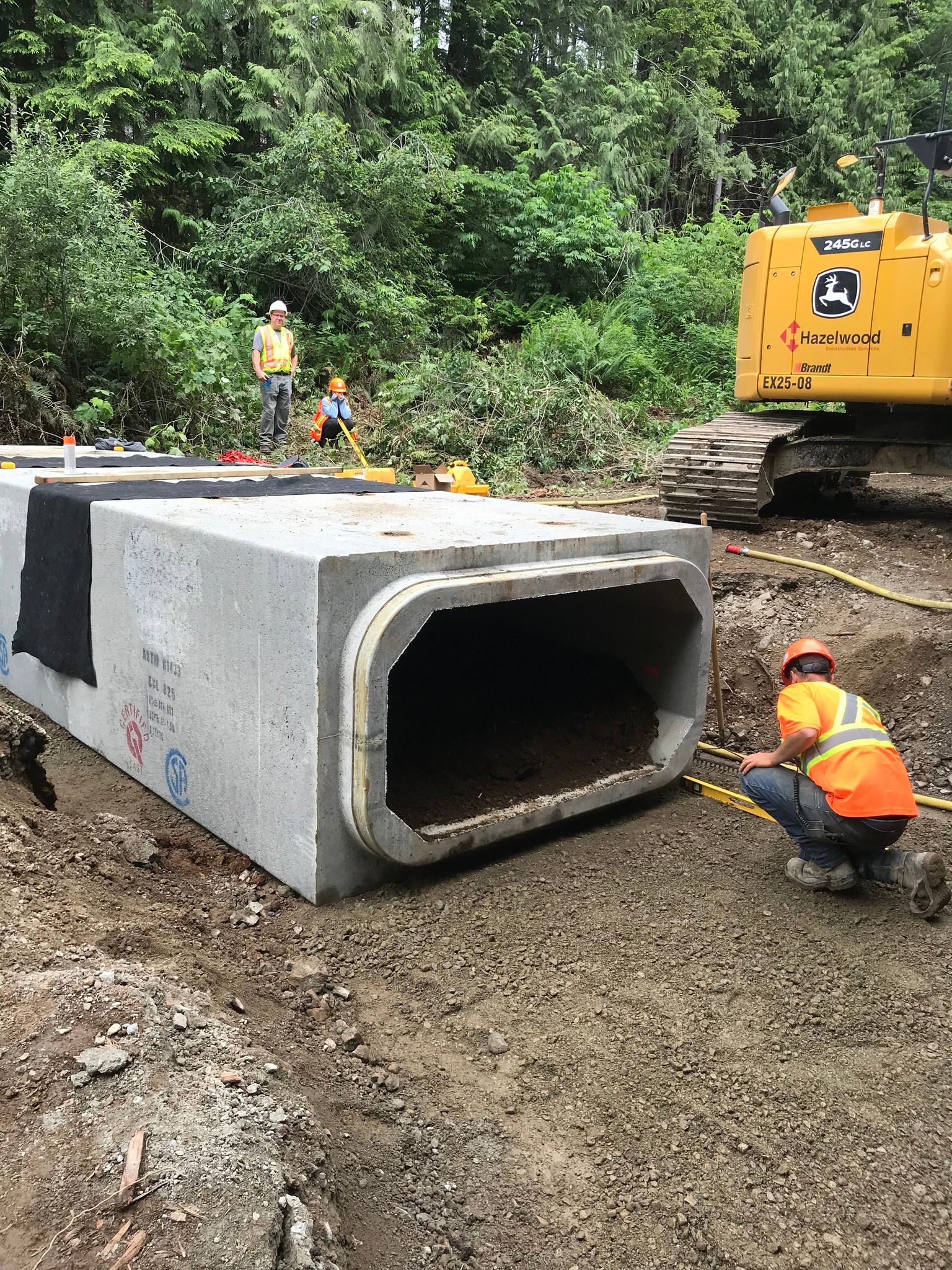
Wetland Stewards worked with engineers at Parsons Corporation to design toad tunnels for the road. They investigated existing drainage culverts to see whether they had the potential to serve as passageways for toadlets. They also looked at provincial guidelines for tunnel structures that would work for adult toads. Using the location data collected on the night surveys, they chose the most concentrated locations for adult crossings as places to put two concrete box culverts. Three existing drainage culverts that occur in peak areas for toadlet dispersal were highlighted for repairs so that they can function for wildlife passages when not carrying water. This is usually the case when the toadlets are moving away from the lake in August and September; the driest time of the year.
In 2021-2022, Huu-ay-aht contributed approximately $10,000 for road surveys, shoreline surveys, barrier installation, and habitat restoration work.
In 2022-2023, it is estimated that Huu-ay-aht will contribute a similar amount for surveys, building fencing to the new culverts, and monitoring movements of toads through the culverts (approximately $10,000 to the project). Huu-ay-aht will also make a substantial investment through the funding for resurfacing the road.
The Association of Wetlands Stewards for Clayoquot and Barkley Sounds welcomes anyone who is keen to come out and volunteer on fence building. Please send an email to wetlandstewards@gmail.com to let them know if you’d be available in August.
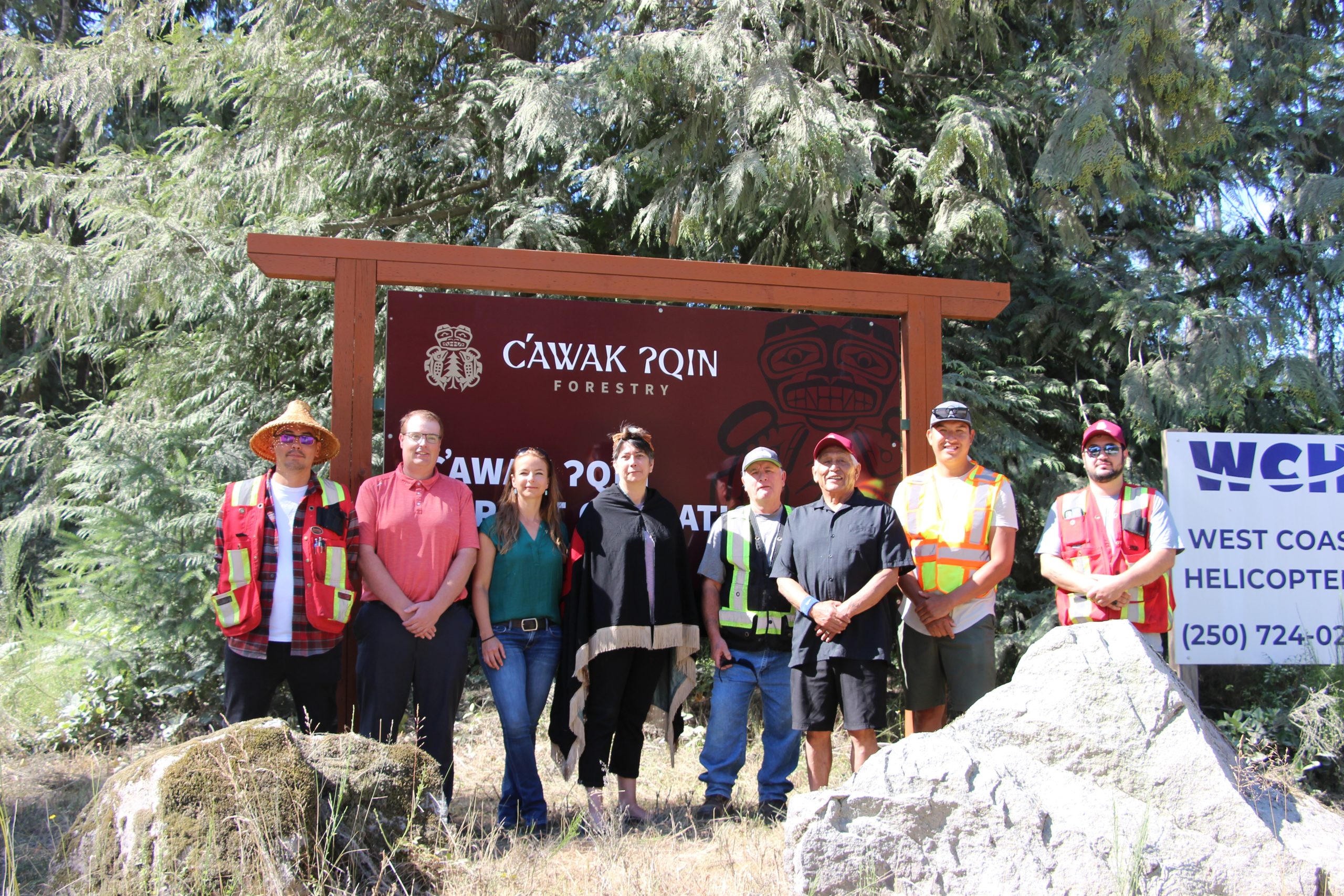
Port Alberni, B.C. – August 2, 2022 – The path forward for C̕awak ʔqin Forestry is now set, with the unveiling today of a new logo and brand that symbolizes the shared vision and values between Huu-ay-aht First Nations (Huu-ay-aht) and Western Forest Products Inc. (Western) in Tree Farm Licence 44 (TFL 44) on Vancouver Island.
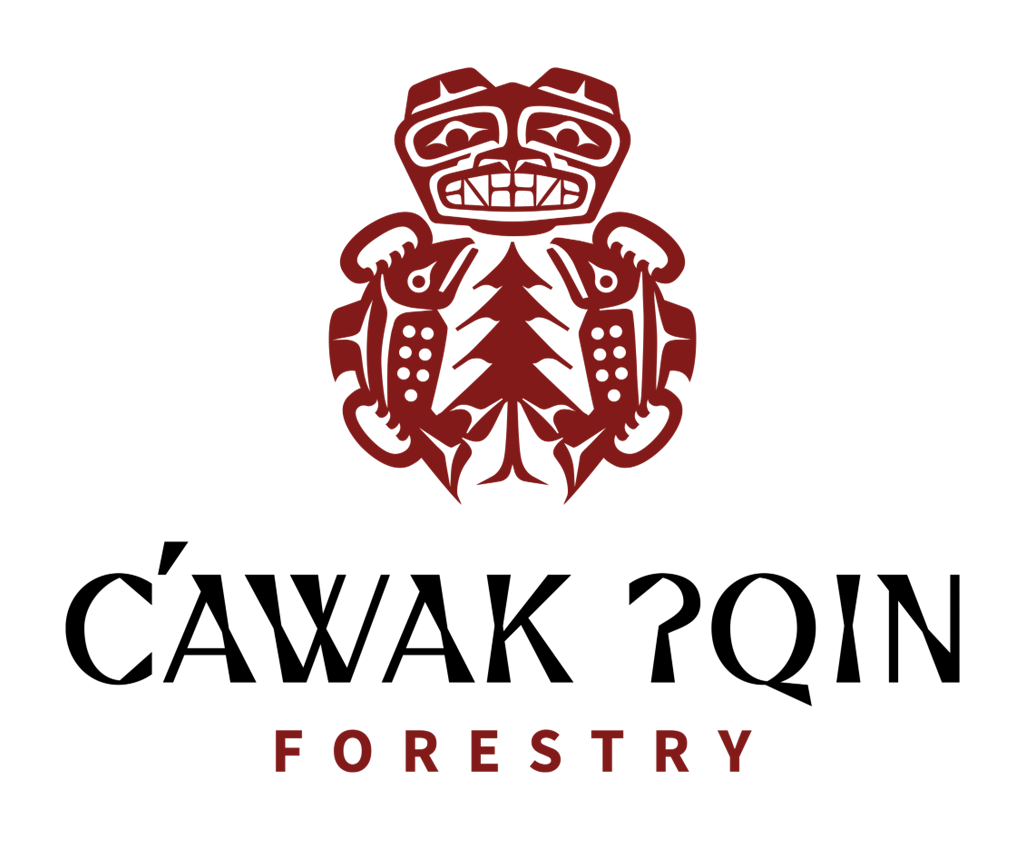
C̕awak ʔqin (pronounced sa-wa-kin) Forestry, which means ‘we are one’ in the Nuu-chah-nulth language, shared the new logo and brand as part of an official operations sign unveiling event at its Franklin River Road office near Port Alberni. The logo was designed by Huu-ay-aht father and son artists, Ed Johnson Sr. and Edward R. Johnson, who is also a Huu-ay-aht Councillor. The logo depicts a bear with its four claws digging into two fish and a growing tree in the centre of the design.
“The salmon is the giver of life and the eagle gave the bear his claws so he could catch the fish that he was coaxing up into the woods,” explained Ed Johnson Sr. “The fish carcasses feed the plants and the trees to help them grow.”
“The design speaks to nature’s lifecycle with all the animals working together to protect, nourish and sustain our lands,” said Edward R. Johnson. “It also reflects the company’s vision as a world leading, Indigenous values-driven company, where our collective decisions benefit the waters, people, fisheries, wildlife and lands today and for future generations.”
“Since time immemorial, storytelling has held an important role in the history, culture and learnings of Huu-ay-aht. It reaffirms what we believe in, what we stand for and passes on the teachings from one generation to the next,” said Robert J. Dennis Sr., Huu-ay-aht Chief Councillor, who was instrumental in the creation of the ground-breaking partnership with Western. “Branding is no different; it’s a modern word for the communication of who we are: we are C̕awak ʔqin, we are one, and the new signage tells all visitors to the TFL that the partners and workers are united in their commitment to manage these forests sustainably according to our Nations’ sacred principles.”
Last October, Huu-ay-aht and Western announced that TFL 44 Limited Partnership had changed its name to C̕awak ʔqin Forestry (also known by its anglicized legal name of Tsawak-qin Forestry Limited Partnership). Since then, feedback was gathered from Huu-ay-aht and Western employees, community leaders, government officials, contractors and suppliers to create the company’s vision, values, branding and design.
“It was clear from these conversations that we all share a common goal: to create a strong and sustainable business where everyone and everything benefits, and where the future is secure,” said Shannon Janzen, RPF, Board Chair for C̕awak ʔqin Forestry and Vice President, Partnerships and Chief Forester of Western. “There was complete alignment that we can only accomplish this by acting as one: C̕awak ʔqin. It is heartening to see the name change in this symbolic sign and sharing the understanding of what this means.”
“This isn’t just a brand; it is a commitment we make to our partners, our employees, the Nation’s citizens and the community at large. It’s about how we show up and what we stand for and a commitment to move forward when everyone is informed and involved,” added Doug Meske, RPF, Senior Manager, Strategic Partnerships, who also oversees the C̕awak ʔqin Forestry operations.
Over the coming days and weeks, the new brand signage will go up across forestry operations in the TFL. To commemorate the launch of the new logo and brand, C̕awak ʔqin has also launched a new brand video.
– 30 –
For media inquiries, contact:
Amanda Munro, C̕awak ʔqin Forestry
amanda@munrothompson.com, 604-360-3994
About C̕awak ʔqin Forestry
C̕awak ʔqin Forestry (Tsawak-qin Forestry Limited Partnership) operates TFL 44 and is a limited partnership between Huumiis Ventures Limited Partnership (wholly owned by Huu-ay-aht First Nations) and Western Forest Products Inc. TFL 44 covers roughly 137,000 hectares of land on west central Vancouver Island in the vicinity of Alberni Inlet and Great Central Lake. More information about the Company’s ground-breaking initiatives can be found here.
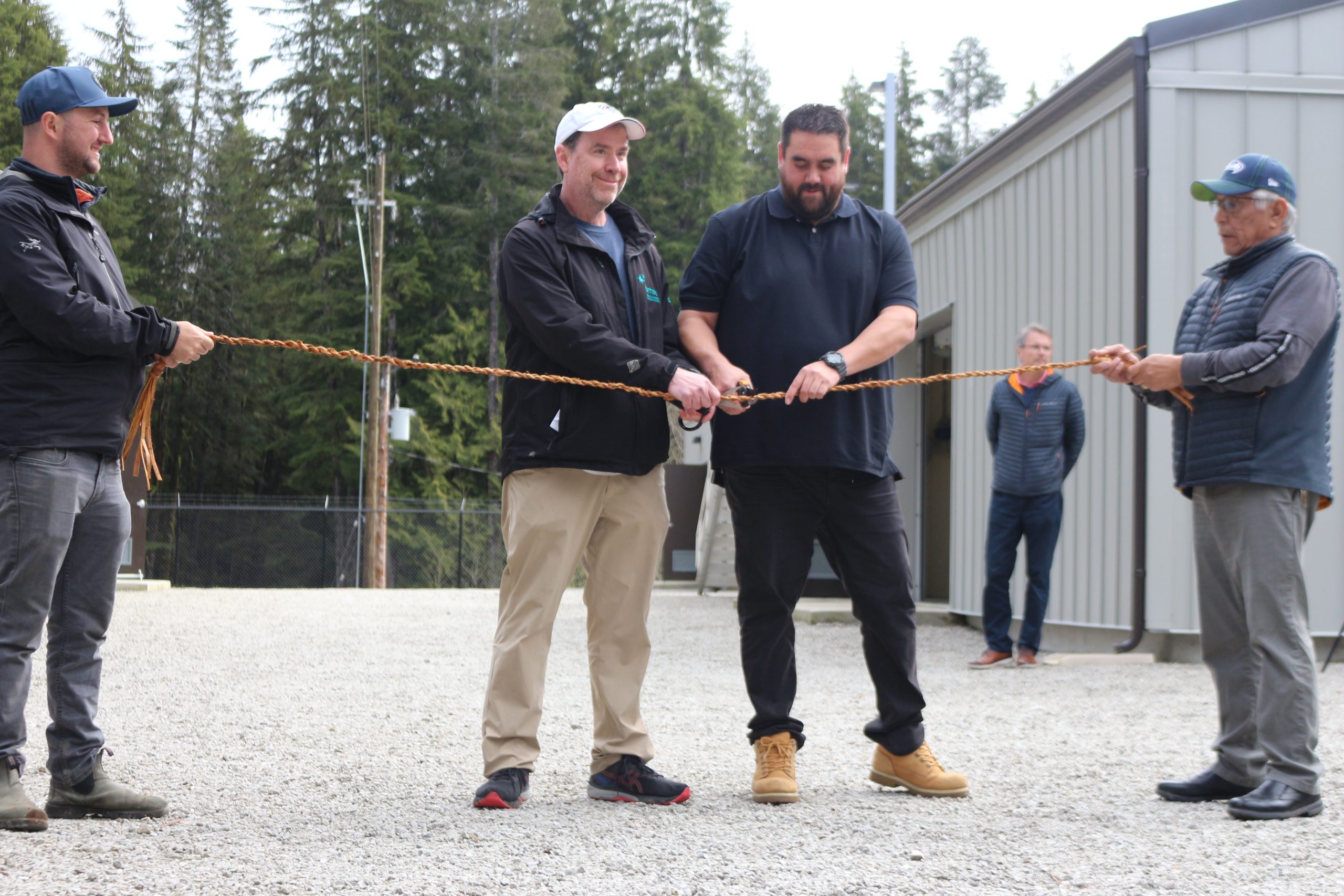
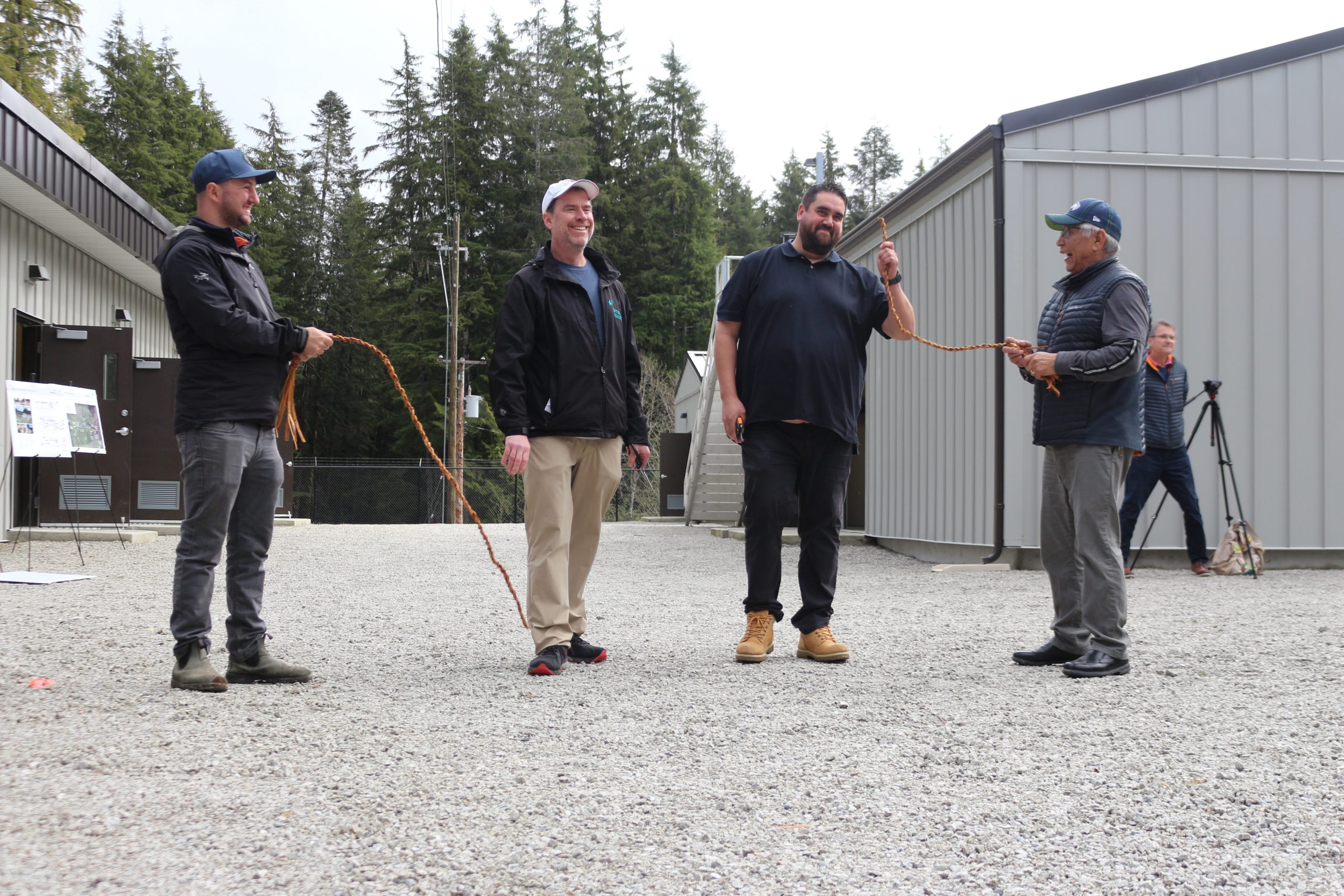
Bamfield Marine Science Centre (BMSC) and Huu-ay-aht First Nations marked the grand opening of the Wastewater Treatment Plant (WWTP) on Friday, April 22, 2022.
This is a project that has been in the works for over 10 years and marked a wonderful day to celebrate.
In 2010, Huu-ay-aht First Nations first conducted feasibility studies to identify where they would construct the WWTP. During this time, BMSC was also looking for options to replace its sewage system. Eight years later, BMSC and Huu-ay-aht signed a memorandum of understanding on April 26, 2018 and chose BMSC lands as the new plant’s location.
Indigenous Services Canada committed $3.6 million, leaving the remaining $4.4 million needed to complete the project. With no other levels of government to help support the project, Huu-ay-aht invested the remaining amount to complete the project.
The $8 million project broke ground back in October 2020 and had its first test on March 17, 2022.
“What better day, then Earth Day, to celebrate the grand opening of the wastewater treatment plant” Said Huu-ay-aht Councillor, Brad Johnson, “Having this plant means less raw sewage being pumped into our local waters and will bring many benefits to the environment, for present and future generations in the Anacla and Bamfield Community.”
Councillor Brad Johnson explained that he recently joined Huu-ay-aht Executive Council and thanks everyone involved and all the hard work they contributed.
Members from the University of Victoria were in attendance, President Kevin Hall, Vice President Indigenous, Qwul’sih’yah’maht Robina Thomas, and Associate Vice President Financial Planning & Operations, Kristi Simpson, to address the attendees.
“We are thankful to Huu-ay-aht First Nations and the community for the wonderful learning environment and everything you do for our students who attend BMSC” said UVIC President, Kevin Hall, “Education is a game changer, and our students always return from BMSC feeling fulfilled”
Kevin Hall explained that they would love to see Huu-ay-aht citizens come to UVIC to attend school and with that, they have a scholarship available to Huu-ay-aht First Nations. More details about the scholarship to come.
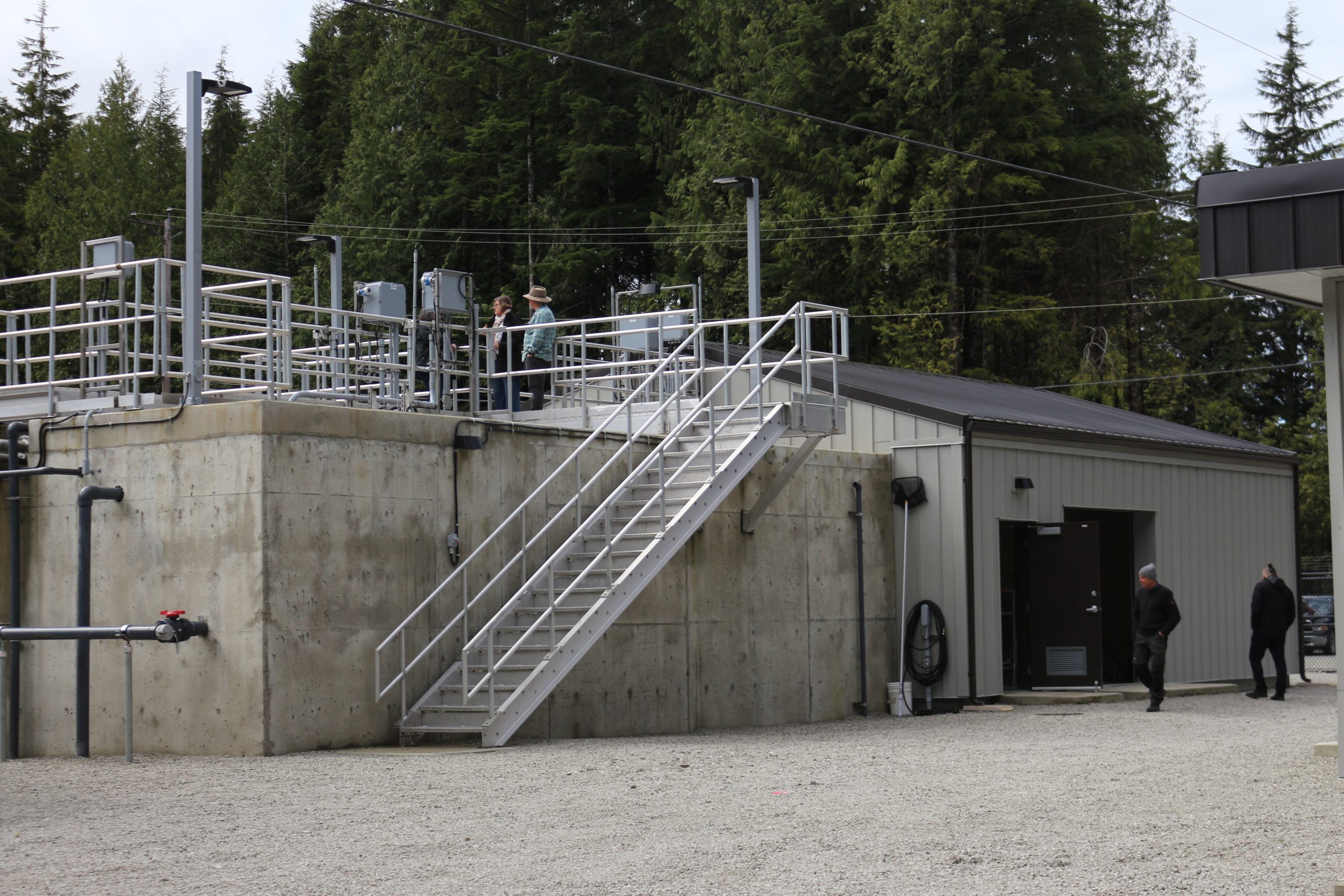
The plant goes through three phases to produce effluent that is suitable for discharge to the surrounding environment or an intended reuse application, thereby preventing water pollution from raw sewage discharges.
The outflow from BMSC was extended from 150 m to 350 m to service the new plant. This will effectively get the clean effluent discharged out into Trevor Channel rather than the mouth of Bamfield Inlet.
The Wastewater Treatment Plant currently services the subdivision on Nookemus Rd. There are plans to have BMSC connected next, very soon.
“On this Earth day, it is fitting to remember that oceans are a planetary life-support system, but only if there are healthy ecosystems” said BMSC Director, Sean Rogers, “A modern wastewater treatment plant will help clean the environment and keep our oceans healthy for generations to come. It feels amazing to have worked together for this common goal that will build a stronger, healthier community.”
Not only has the plant set a cleaner future for the Bamfield community, but it has also created two new jobs, a primary operator, and a backup operator. The position is yet to be filled.
For more information: Amanda-Lee Cunningham Communications Manager, Huu-ay-aht First Nations amanda.c@huuayaht.org | 250-720-7776
On April 28, 2022, Huu-ay-aht First Nations and C̕awak ʔqin Forestry hosted the Anacla Old Growth Summit bringing coastal nations together to discuss information on their stewardship and resource management planning and decision-making processes.
The Summit was led by MC, and Tayii Ḥaw̓ił ƛiišin speaker, Wišqii (Robert Dennis Jr.).
To open the meeting, Wišqii performed a prayer chant. He explained that the chant is of gratitude, that every day you are going to hold close to you what you value and what you cherish, including family, community, and things like vast resources that surround you.
Representing Huu-ay-aht at the front of the room were, Ḥaw̓iiḥ Council (hereditary chiefs), Tayii Ḥaw̓ił ƛiišin Derek Peters (head hereditary chief), Jeff Cook, Darlene Nookemis, Larry Johnson (sitting in for Tommy Happynook), Zelda Clappis (sitting in for Andrew Clappis), and Alec Frank. From Executive Council, Chief Robert Dennis Sr., and Council members Trevor Cootes, Edward R. Johnson, and Brad Johnson.
“Ḥaw̓iiḥ Chiefs are here forever, their seats will never disappear,” said Chief Councillor Robert Dennis Sr.. “We know what the principles of our hereditary leaders are and that’s the biggest advantage we have as Huu-ay-aht First Nations, the ḥaw̓iiḥ will guide how we manage our forests.”
The Summit was conducted in accordance with Huu-ay-aht’s Three Sacred Principles of: ʔiisaak (utmost respect), ʔuuʔałuk (taking care of), Hišuk ma c̕awak (everything is one). These three sacred principles are what guide Huu-ay-aht for present and future generations.
“These are strong values that are held by our chief houses and that is something we have never gone away from,” said Tayii Ḥaw̓ił ƛiišin Derek Peters. “We are in a historic time where we are starting to merge these traditional ways on how we manage our resources. It is through our resources, that we survived. We still need, we still harvest, and we still thrive off our territory today.”
Huu-ay-aht had the privilege of hearing from the Honourable Katrine Conroy, Minister of Forests, who joined the summit virtually to address the attendees.
“We are continuing to support indigenous communities and respect the decision and right titleholders who have made it clear that they don’t support any more old-growth deferrals in their territory,” said Minister Katrine Conroy. “It’s so encouraging to see nations like Huu-ay-aht First Nations, taking these steps to manage the important forestry values for your community based on the best available scientific data and local indigenous knowledge.”
Following Minister Conroy was Nuu-chah-nulth Tribal Council (NTC) President Judith Sayers.
“It is time for First Nations to manage their own lands according to their own values,” said NTC President Judith Sayers. “We have seen Huu-ay-aht assert their title, assert their rights and assert their management, they’ve shown the world that they can do so.”
Presentations on stewardship and resource management planning and decision-making processes were made by Chief Mark Point of Skowkale First Nations, Chief Don Svanvik and Mike Green of ‘Namgis First Nations, Shannon Janzen of C̕awak ʔqin Forestry, and Tayii Ḥaw̓ił ƛiišin Derek Peters and Marina Rayner of Huu-ay-aht First Nations.
Huu-ay-aht First Nations and C̕awak ʔqin Forestry are pleased to announce Honourable Minister Katrine Conroy as a keynote speaker at the Anacla Old Growth Summit on April 28, 2022.
As the B.C. Minister of Forests, Katrine Conroy is responsible for the stewardship of provincial Crown land and ensures the sustainable management of forest, wildlife, water, and other land-based resources. The Ministry works with Indigenous and rural communities to strengthen and diversify their economies.
Along with Minister Katrine Conroy, there will also be presentations from ‘Namgis First Nation, Skowkale First Nation, Huu-ay-aht First Nations and C̕awak ʔqin Forestry.
“The time is now for First Nations to take back responsibility for the stewardship of the land and lead the decision making processes when it comes to how to plan for and manage our natural resources,” said Robert J. Dennis Sr., Chief Councillor, Huu-ay-aht First Nations. “This Summit will enable sovereign Nations to share the important work they are doing and stewardship decisions they are making for the benefit of their members or citizens, their lands and waters, and all British Columbians. Our land is our culture and it is our stewardship decisions that count.”
March 9, 2022 – Anacla, British Columbia – C̕awak ʔqin Forestry (Tsawak-qin Forestry Limited Partnership) and Huu-ay-aht First Nations announce April 28, 2022 as the new date for the Anacla Old-Growth Summit. Tayii Ḥaw̓ił ƛiišin (Derek Peters, Head Hereditary Chief, Huu-ay-aht First Nations) and Elected Chief Councillor Robert J. Dennis, Sr. will host the Summit which will take place in Anacla, B.C. C̕awak ʔqin Forestry and Huu-ay-aht Forestry Limited Partnership will participate as co-chairs. This Summit was originally planned for November 2021 but was deferred due to COVID-19 restrictions.
The Summit will bring together 50 coastal Indigenous nations to share information on their stewardship and resource management planning and decision making processes. These Indigenous-led models not only cover all values such as old growth, fisheries, culture and climate change, but incorporate the research and advice of leading experts that Indigenous governments have retained in forestry, fisheries and ecosystem management.
Together, these processes provide clear Indigenous-led direction to provincially-legislated procedures on forest landscape plans, old-growth management and on-the-ground operational planning, while ensuring long-lasting socio-economic, environmental and cultural benefits for everyone across the area.
“As sovereign nations, we know how much old growth is left and we know the key priority is planning for what happens in the long term,” said Robert J. Dennis Sr., Chief Councillor, Huu-ay-aht First Nations. “There has been much debate in recent months over how much old growth is left and how much is being deferred for the next two years. That debate is over. This Summit will enable sovereign Nations to share the important work they are doing and stewardship decisions they are making for the benefit of their members or citizens, their lands and waters, and all British Columbians. Our land is our culture and it is our stewardship decisions that count.”
In stark contrast to public conversations to date, this Summit will reflect the depth and broad range of professionals, academics and subject matter experts who advise sovereign Nations. It will highlight the important ways in which sovereign nations across the coast are already drawing on the wisdom and expertise of their communities, their partners, and the experts they have retained to exercise their inherent stewardship rights as Indigenous governments.
“As sovereign nations we know the lands and waters better than anyone, and it is our responsibility to balance the many competing interests, not third parties and environmental groups,” said Tayii Ḥaw̓ił ƛiišin (Derek Peters), Head Hereditary Chief, Huu-ay-aht First Nations. “Stewardship and old growth decisions for present and future needs of nations and the ecosystems on their lands are to be made in a manner that benefits all. This is a move away from endless, unproductive debates amongst experts, environmental groups, industry, and protesters about how much old growth is left and how much needs to be protected for the next two years.”
The Summit will provide an opportunity to introduce the Indigenous Witwak Guardians who have the important work of protecting, monitoring and enhancing C̕awak ʔqin Forestry operations. Their role is to bring awareness to all invited land users on traditions and protocols one must adhere to while visiting or working in the area including TFL 44 and other Huu-ay-aht tenures.
Anacla Old-Growth Summit organizers will provide information on the agenda, guests and speakers as they become available.
The total productive forested area within the Hahuuli and TFL 44 is 153,773 hectares (ha), of which 51,240 ha, or 33 per cent, is old forest (greater than 250 years old).
Based on a review of maps provided by the provincial government to the Nation, Huu-ay-aht First Nations will continue to uphold our right to old-growth harvesting in four per cent of the Technical Advisory Panel (TAP) proposed deferral area in the Huu-ay-aht Ḥahuułi and TFL 44. The Nation has decided on a preliminary basis to defer harvesting for a period of two years in areas that make up 96% of the TAP proposal for old growth deferrals, much of which is already protected under existing conservation measures or not planned for harvest in the next two years.
Beginning in 2023, Huu-ay-aht’s long-term stewardship decisions will be informed by the outcome of Huu-ay-aht’s two-year Hišuk ma c̕awak Integrated Resource Management Planning process.
“As a Modern Treaty Nation, Huu-ay-aht will decide how best to manage our lands and resources guided by our three Sacred Principles of ʔiisaak (utmost respect), ʔuuʔałuk (taking care of), and hišuk ma c̕awak (everything is one),” said Tayii Ḥaw̓ił ƛiišin. “We expect broad recognition and respect for our old growth two-year deferral decisions and our long-term forest and resource stewardship decisions.”
“We have now confirmed that 33 per cent, not three per cent, of our Ḥahuułi and TFL 44 is old growth,” said Chief Councillor Robert J. Dennis Sr. “By approving 96 per cent of the TAP old growth recommendation, much of which is already protected under existing conservation measures or not planned for harvest in the next two years, we are satisfied that sufficient old forest is protected, while we complete our two-year integrated resource management planning process and make our long-term forest and resource stewardship decisions.”
– 30 –
For more information, contact:
Heather Thomson
Communications Manager, Huu-ay-aht First Nations
250-720-7776, heather.t@huuayaht.org
About Huu-ay-aht First Nations
Huu-ay-aht First Nations is an indigenous community located on the west coast of Vancouver Island in British Columbia. It is a part of the Nuu-chah-nulth Nation, formerly called the Nootka. Huu-ay-aht is a party to the Maa-nulth Final Agreement, a modern treaty that grants its five member-nations constitutionally protected self-government as well as ownership, control, and law-making authority over their lands and resources. For more information, visit huuayaht.org.
Backgrounder
Huu-ay-aht preliminary determination Old Growth Deferrals proposed by the Technical Advisory Panel (TAP) for the Huu-ay-aht Ḥahuułiand TFL 44
Huu-ay-aht has completed a preliminary review of two-year old growth deferrals proposed by the Technical Advisory Panel (TAP) for the Huu-ay-aht Ḥahuułi (Territory) and TFL 44 (Huu-ay-aht beneficially owns 35 per cent of C̕awak ʔqin Forestry (TFL 44). Please refer to Table 1.
The total productive forested area is 153,773 ha, of which 51,240 ha, or 33 per cent, is old forest (greater than 250 years old). TAP recommends that Huu-ay-aht approve a two-year deferral of old-growth harvesting in 14,754 ha, or 29 per cent, of that total old forest.
Based on maps provided to Huu-ay-aht by the provincial government, the TAP two-year deferral request has been compared to planned harvest areas within the Huu-ay-aht Ḥahuułi and TFL44. 14,109 hectares of the 14,754 ha TAP deferral request (96 per cent) is not planned for harvest within the next two years. In many cases, harvesting is already not taking place because of existing conservation measures.
Huu-ay-aht has analyzed the remaining 645 ha of proposed deferrals (4 per cent of TAP request, or 0.4 per cent of total forested area), and has determined that implementation of those remaining deferrals would result in significant economic harm to Huu-ay-aht, local workers, Bamfield, and the Alberni Region. Because of how these proposed deferral areas are distributed, they put as much as 65 per cent of planned harvest volume over the next two years in serious jeopardy.
These deferrals would have an impact on small portions of many different harvest areas in a variety of ways, including making entire harvest areas uneconomic or inaccessible or making the deferred portion subject to forest health concerns such as windthrow.
TABLE 1 – OLD GROWTH DEFERRAL ANALYSIS
Description
Ḥahuułi& TFL 44 Area (ha)
Percentages
Total Productive Forest Area
153,773 ha
100%
Total Old Forest
51,240 ha
33%
TAP Request for Two-Year Harvest Deferral
14,754 ha
29% of Total Old Forest
Portion of TAP Deferral Request not Planned for Harvest in two years, or in many cases forever
14,109 ha
96% of TAP Deferral Request
Portion of TAP Deferral Request which impacts planned harvest areas
645 ha
4% of TAP Deferral Request
Potential drop in volume of annual harvest for next 2 years
65%
After giving this matter and all relevant circumstances careful consideration, Huu-ay-aht First Nations has made a determination to approve on a preliminary basis, for the next two years, 96 per cent of the TAP proposal for old growth deferrals.
However, on a preliminary basis, Huu-ay-aht First Nations does not approve the remaining 4 per cent of the TAP request for two-year deferrals for two main reasons:
Huu-ay-aht is satisfied that sufficient old forest is protected without the additional 4 per cent old growth deferral, and
Approving the remaining 4 per cent of the TAP deferral request would have a significant adverse impact on workers, earnings, and the Nation that goes far beyond any incremental ecological benefit.
It is important to note that this determination is preliminary in nature and is specific to the Huu-ay-aht. Huu-ay-aht does not speak for other Nations. As Huu-ay-aht proceeds with its own expert analysis to support its final determination, the Nation may learn more about deferral options and current old growth protection measures on the Ḥahuułi and TFL 44 that reduce, increase, or otherwise change the amount of two-year old growth harvest deferral that Huu-ay-aht finally determines is necessary. Huu-ay-aht expects to make a final determination on Huu-ay-aht deferrals by mid-January 2022.
Huu-ay-aht First Nations announces that Tayii Ḥaw̓ił ƛiišin (Head Hereditary Chief Derek Peters) and Elected Chief Councillor Robert J. Dennis, Sr. will host the Anacla Old-Growth Summit on November 23, 2021, on old-growth management and process for Huu-ay-aht’s Hišuk ma c̕awak Integrated Resource Management Plan (HIRMP). C̕awak ʔqin Forestry and Huu-ay-aht Forestry Limited Partnership will participate as co-chairs.
The purpose of the summit is to hear from forestry professionals regarding discrepancies in the scientific data related to old growth (the “science gap”), to tour the Huu-ay-aht ḥahuułi (traditional territory of the hereditary chief), and to discuss Huu-ay-aht’s approach to old-growth management and the Huu-ay-aht Integrated Resource Management Plan (HIRMP) process.
The B.C. Government is expected to publicly propose further old-growth deferrals and changes to forest practices soon. If large scale deferrals are announced and implemented, this would have severe adverse impacts on the safety and economic well-being, cultural and spiritual survival of our people, and the sustainability of our lands. The need for large scale deferrals would likely be justified by reliance on the untested assertion in 2020 by technical advisors to B.C. that there is only three per cent of productive old growth left in BC. Other forestry technical advisors say there is 30 per cent of similarly labelled productive old growth left within a highly protected land-base. As the rights and title holders who make the final decisions on forestry in our Territory, Huu-ay-aht needs to close this science gap.
Those who attend the Anacla Old-Growth Summit will have the opportunity to discuss how Huu-ay-aht stewardship decisions across the hahuułi are guided by the Hišuk ma c̕awak Declaration signed by Ditidaht, Huu-ay-aht, and Pacheedaht First Nations on June 7, 2021 and the United Nations Declaration on the Rights of Indigenous Peoples (UNDRIP).
“As a Modern Treaty Nation, Huu-ay-aht will decide how best to manage our lands and resources. We expect broad recognition and respect for the Declaration and UNDRIP,” said Tayii Ḥaw̓ił ƛiišin. “We need to end the types of protests that threaten the safety and economic well-being, cultural and spiritual survival of our people, and the sustainability of our lands. In our culture that starts by coming together to discuss how we can engage in a manner guided by our three Sacred Principles of ʔiisaak (utmost respect), ʔuuʔałuk (taking care of), and hišuk ma c̕awak (everything is one).”
Huu-ay-aht has invited the Hereditary and Elected Chiefs of Pacheedaht and Ditidaht Nations to the summit as the three nations share a common interest in full implementation of the Hišuk ma c̕awak Declaration. The discussions may also inform future decisions in relation to Fairy Creek and the Central Walbran.
Environmental leader Tzeporah Berman, resource journalist Stewart Muir, forest professionals Al Gorley, Garry Merkel, Rachel Holt, and Cam Brown, and Indigenous leaders, have been invited to the Anacla Old-Growth Summit.
Forest professionals working with Huu-ay-aht, including Bruce Blackwell, Chris Niziolomski, and Stan Coleman, will attend the summit, along with Shannon Janzen, chair of C̕awak ʔqin Forestry. “Forestry professionals and environmental leaders invited to this summit have issued reports that include widely conflicting estimates of remaining old-growth in B.C., from three to 30 per cent, and its current level of protection,” said Chief Councillor Robert J. Dennis Sr. “These reports have also recommended differing forest management strategies. To inform our stewardship decisions for our ḥahuułi and to assist others in B.C. more generally, we wish to hear directly from report authors and others who are experts in the field. We need to close what I call the science gap. The Huu-ay-aht government will make its own stewardship decisions as it relates to the risks and benefits from our forests. We need to move to re-establish what I call indigenous-based forest management (IBM).”